Global equities: where we do stop on the tariff staircase?

May 23, 2025

It’s remarkable global equity markets are up year-to-date given the extent of policy uncertainty. Jeremy Richardson explains the three potential tariff steps on the ‘Stairway to Liberation’, and discusses current market consensus and strategies to manage policy uncertainty in equity portfolios.

Key takeaways

  • The ongoing debate over trade policy and tariffs continues to create uncertainty in equity markets. The strength of the market rotation from the U.S. to Europe has diminished.
  • Q1 earnings were better than feared. But the range of policy outcomes remains wide and not everyone has been convinced by the recovery in equity markets.
  • Recent volatility is a reminder of the risks of macro-biases in portfolios. Careful monitoring and management of these will allow portfolio returns to be driven by individual holdings, in particular, quality companies run by strong management teams.


Tariff uncertainty collided with post-election optimism earlier this year. De-regulatory supply-side policies have a deflationary bias considered positive for corporate profits. Tariffs, on the other hand, have to be paid for, pushing up prices and disrupting supply chains. Fears of recession increased, creating ‘push’ factors for capital to leave the U.S.. This is in contrast to Europe where security fears encouraged governments to prioritise rearmament spending at the same time as interest rates continued to be cut.

Investors and companies still don’t have the tariff policy certainty they crave. Different voices argue for different outcomes, creating a ‘stairway to liberation’ of compounding policy actions.

The tariff ‘stairway to liberation’
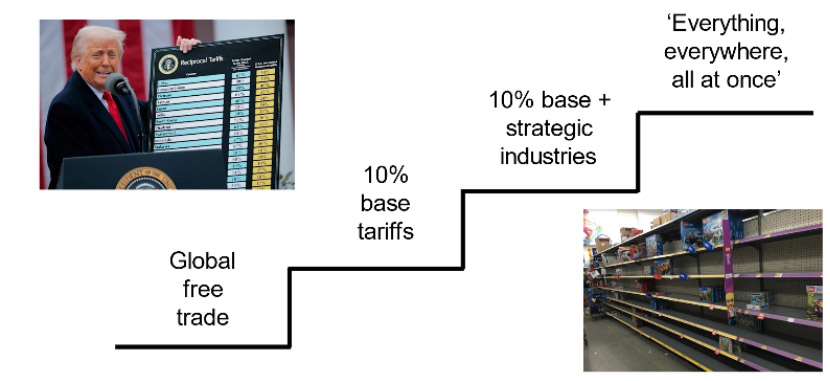
The tariff staircase: a tricky climb

The first step, a 10% tariff on all imports, would be frustrating for companies, investors and consumers. But it would likely not force companies to rapidly change supply chains and would raise significant revenue for government coffers.

Some argue it doesn’t go far enough. The next step builds on the first by adding in tariffs on strategic industries, like rare earths, semiconductors and pharmaceuticals to encourage domestic re-shoring and support U.S. economic security. This is a more interventionist approach but if limited to specific business models, it is one that the market should be able to price effectively.

The final step is essentially the full ‘Rose Garden’ treatment with reciprocal tariffs based upon existing trade deficits, in particular with China, with the goal of reindustrialisation. This last step was quickly priced into equity markets after the ‘Rose Garden’ announcement elevated the risk of recession.

Empty shelves in Walmart?

The 90-day moratorium on new tariffs came as a significant relief to equity markets. The implicit signal was that the risk of ‘everything, everywhere, all at once’ is significantly reduced. It was a well-timed intervention. Orders for Halloween and Christmas retail inventory need to be placed around now if product is to arrive in time, with delays risking empty shelves at Walmart. President Trump doesn’t want to be the President who cancelled Christmas.

Market consensus has moved back down the stairway and now appears to be somewhere between steps 1 and 2.

This is a better outcome than feared in early April that has helped equity markets recover their early Spring losses. The implied risk of recession has fallen from above 50% to somewhere in the 30s% (compared to a notional probability of 20-25% in any given year).

The only certainty is uncertainty

There are a few things we don’t yet know. Firstly, will there be a long-lasting trade agreement between the U.S. and China? Scott Bessent, Treasury Secretary, has said that neither country wants to ‘decouple’ from the other, which if true may indicate a settlement is possible. But this is in conflict with the re-industrialisation objective that requires a degree of inevitable decoupling, so who is right?

Secondly, even if outline deals are agreed in the next 60 days, will they be strong enough to give companies the confidence to invest? Or will delays cause an activity air-pocket and push the U.S. into recession anyway?

Finally, might we be looking at stagflation (lower growth and inflation above 2% for longer) or a ‘Goldilocks’ economy (3% growth and inflation 2-3%) in future? The market is looking for clues, hence the focus on ‘soft’ (current survey data) and ‘hard’ (backward-looking official data) economic indicators. Results so far are somewhat ambiguous.

So far, companies’ reported Q1 earnings have been better than feared. But Q1 was arguably always a ‘pass’ given that tariffs weren’t fully announced until the beginning of Q2. Earnings estimates have held up surprisingly well, despite ongoing policy uncertainty, but profit estimates often fade through the second half. Given valuations have recovered, this is leading many investors to ask ‘now what?’

Is the ‘great rotation’ taking a summer break?

The market rotation from the U.S. to Europe feels as though it has stalled. Tech stocks and ‘retail favourites’, such as Tesla, have been doing better lately. It is probably dangerous to be too dismissive of the U.S.. The natural advantages the country has in terms of its innovation-friendly eco-system, expanding demographics and high labour productivity all still mean that anyone looking to allocate their marginal dollar will have to consider the U.S. economy. The popularity of passive investment solutions in the U.S. also continues to act as a magnet for global capital as firms look to list in a market where passive means there is a surfeit of wealthy, value-agnostic investors.

In contrast, Europe has potential, but we have yet to see sustained commitment to the type of economic reforms and liberalisation that were set out in Mario Draghi’s 2024 report. A re-ordering of spending priorities in favour of defence is making new funds available which, together with falling interest rates, is supporting hopes of an improved environment to corporate profitability. However, this is a simple transient multiplier effect to growth – sustained economic growth probably requires supply-side reforms, the appetite for which remains unclear. A useful test-case for investors to monitor is cross-border banking consolidation, such as UniCredit’s approach to Commerzbank.

We let our companies do the talking

Our approach is a focus on company fundamentals, especially quality companies run by strong management teams, as they will be more resilient and will likely be able to take advantage of industry change better than weaker competitors. It is also important not to forget risk. Recent market volatility has highlighted the dangers of taking a strong market (beta) or country (U.S. versus Europe) view. Better to diversify such macro risks, monitor positive momentum exposure by not letting position sizes drift too far and let the company holdings do the talking.


Source: Bloomberg or publicly available data, as at May 2025.

Inscríbase para recibir las Perspectivas por email

Suscríbase ahora para recibir las últimas perspectivas económicas y de inversión de nuestros expertos directamente en su bandeja de correo.

Este documento es una comunicación de marketing y puede ser producido y emitido por las siguientes entidades: en el Espacio Económico Europeo (EEE), por BlueBay Funds Management Company S.A. (BBFM S.A.), sociedad regulada por la Commission de Surveillance du Secteur Financier (CSSF). En Alemania, Italia, España y los Países Bajos, BBFM S. A opera con un pasaporte de sucursal con arreglo a lo dispuesto en la Directiva sobre organismos de inversión colectiva en valores mobiliarios (2009/65/CE) y la Directiva relativa a los gestores de fondos de inversión alternativos (2011/61/UE). En el Reino Unido por RBC Global Asset Management (UK) Limited (RBC GAM UK), sociedad autorizada y regulada por la Financial Conduct Authority (FCA) del Reino Unido, registrada ante la Securities and Exchange Commission (SEC) de los Estados Unidos y miembro de la National Futures Association (NFA) autorizada por la Commodity Futures Trading Commission (CFTC) de los Estados Unidos. En Suiza, por BlueBay Asset Management AG, país en el que el Representante y Agente de pagos es BNP Paribas Securities Services, Paris, succursale de Zurich, Selnaustrasse 16, 8002 Zurich (Suiza). El lugar de ejecución es el domicilio social del Representante. Los órganos judiciales del domicilio social del representante suizo o el domicilio social o lugar de residencia del inversor tendrán la competencia para conocer las reclamaciones relacionadas con la oferta o publicidad de acciones en Suiza. El Folleto, los Documentos de datos fundamentales para el inversor (KIID), los documentos de datos fundamentales (KID) de los PRIIP (productos de inversión minorista vinculados y los productos de inversión basados en seguros), cuando proceda, la escritura de constitución y cualquier otro documento necesario, por ejemplo, los informes anuales y semestrales, pueden obtenerse de manera gratuita solicitándolos al Representante en Suiza. En Japón, por BlueBay Asset Management International Limited, sociedad registrada ante la Kanto Local Finance Bureau del Ministerio de Finanzas de Japón. En Asia, por RBC Global Asset Management (Asia) Limited, sociedad registrada ante la Comisión del Mercado de Valores y Futuros de Hong Kong. En Australia, RBC GAM UK se encuentra exenta del cumplimiento de la obligación de poseer una licencia de servicios financieros australiana en virtud de la Ley de sociedades (Corporations Act) para la prestación de servicios financieros, ya que está regulada por la FCA de acuerdo con la legislación del Reino Unido, que difiere de la australiana. En Canadá, por RBC Global Asset Management (incluido PH&N Institutional), sociedad regulada por cada una de las comisiones provinciales y territoriales del mercado de valores ante la que esté registrada. RBC GAM UK no se encuentra registrada en virtud de la legislación sobre valores negociables, sino que se acoge a la exención para operadores internacionales contemplada por la legislación provincial aplicable a esta materia, la cual permite a RBC GAM UK llevar a cabo determinadas actividades específicas como operador para los residentes canadienses que tengan la calificación de «cliente canadiense permitido» (Canadian permitted client), según la definición de dicho término en la legislación aplicable a valores negociables. En Estados Unidos, por RBC Global Asset Management (U.S.) Inc. («RBC GAM-US»), asesor de inversiones registrado ante la SEC. Las entidades señaladas anteriormente se denominan colectivamente «RBC BlueBay» en el presente documento. No debe interpretarse que las afiliaciones y los registros mencionados comportan un apoyo a RBC BlueBay ni tampoco su aprobación por parte de las respectivas autoridades competentes en materia de licencias o registros. No todos los productos, servicios e inversiones que se describen en el presente documento están disponibles en todas las jurisdicciones, y algunos de ellos solo lo están de forma limitada, debido a las exigencias jurídicas y normativas locales.

El documento va dirigido exclusivamente a «Clientes Profesionales» y «Contrapartes Elegibles» (como se define en la Directiva relativa a los mercados de instrumentos financieros [«MiFID»]); o en Suiza a los «Inversores Cualificados», tal y como se definen en el Artículo 10 de la Ley suiza de organismos de inversión colectiva y su ordenanza de aplicación; o en Estados Unidos a «Inversores Acreditados» (según la definición de la Ley de valores negociables [Securities Act] de 1933) o «Compradores Cualificados» (conforme a la definición de la Ley de sociedades de inversión [Investment Company Act] de 1940), según sea aplicable, y ninguna otra categoría de cliente debería basarse en él.

Salvo indicación en contrario, todos los datos proceden de RBC BlueBay. Según el leal saber y entender de RBC BlueBay, este documento es veraz y correcto en la fecha de su emisión. RBC BlueBay no otorga ninguna garantía ni realiza ninguna manifestación ni expresa ni tácita con respecto a la información incluida en este documento y excluye expresamente en este acto toda garantía de exactitud, integridad o adecuación a un fin concreto. Las opiniones y estimaciones están basadas en nuestro propio criterio y podrían cambiar sin previo aviso. RBC BlueBay no proporciona asesoramiento de inversión ni de ningún otro tipo. El contenido del presente documento no constituye asesoramiento alguno ni debe interpretarse como tal. El presente documento no constituye una oferta para vender, ni una solicitud de una oferta para comprar, ningún título o producto de inversión en ninguna jurisdicción. Esta información se ofrece únicamente a efectos informativos.

Queda prohibida toda reproducción, redistribución o transmisión directa o indirecta de este documento a cualquier otra persona, o su publicación, total o parcial, para cualquier fin y de cualquier modo, sin el previo consentimiento por escrito de RBC BlueBay. Copyright 2023 © RBC BlueBay. RBC Global Asset Management (RBC GAM) es la división de gestión de activos de Royal Bank of Canada (RBC) que incluye a RBC Global Asset Management (U.S.) Inc. (RBC GAMUS), RBC Global Asset Management Inc., RBC Global Asset Management (UK) Limited y RBC Global Asset Management (Asia) Limited, entidades mercantiles independientes, pero vinculadas. ® / Marca(s) registrada(s) de Royal Bank of Canada y BlueBay Asset Management (Services) Ltd. Utilizada(s) con autorización. BlueBay Funds Management Company S.A., con domicilio social en 4, Boulevard Royal L-2449 Luxemburgo, sociedad registrada en Luxemburgo con el número B88445. RBC Global Asset Management (UK) Limited, con domicilio social 100 Bishopsgate, London EC2N 4AA, sociedad registrada en Inglaterra y Gales con el número 03647343. Todos los derechos reservados

Inscríbase para recibir las Perspectivas por email

Suscríbase ahora para recibir las últimas perspectivas económicas y de inversión de nuestros expertos directamente en su bandeja de correo.