Key takeaways:
- A strategic allocation too big to ignore: at close to US$5 trillion, the global securitized credit market is now larger than the US high yield bond market. We believe its track record of attractive risk-adjusted returns, aided by its structural protection against downside risks, warrants a long-term allocation in investor portfolios.
- A versatile spectrum of portfolio roles: what distinguishes securitized credit is the array of portfolio roles it can play. It offers a cash enhancement at the senior end, can complement investment grade corporate bond exposures, and provide a source of income above high yield in lower mezzanine tranches, all within a single, regulated market.
- Differentiated return drivers: unlike corporate bonds, securitized credit returns are shaped by a distinct combination of factors – a diversified collateral base with lower correlation to corporate credit, structural cash flow waterfalls that prioritise repayment, typically floating rate coupons that reduce interest-rate sensitivity, and favourable supply-demand technicals. Together, these drivers create a broader spectrum of portfolio applications.
Securitized credit is an increasingly important component of the global fixed income market, now accounting for around US$5 trillion globally (excluding US agency MBS). This is larger than the US high yield market, and yet the asset class remains structurally under-represented in most institutional portfolios.
Securitized credit has historically offered a differentiated risk and return profile when compared to other fixed income sources. This has been underpinned by features such as diverse collateral exposures, structural protection, and a predominantly floating-rate nature.
Critically, the spectrum of risk and return profiles within the asset class means it can serve multiple roles within a fixed income portfolio:
- as a cash enhancement in the liquid high-grade, short spread duration space;
- as a complement to traditional investment grade exposures;
- and as a source of income in excess of corporate high yield and the loans market, in lower mezzanine positions.
Further to our primer, Securitized credit: an asset class primer, in this note we explore the solutions that the asset class can offer today.
What different roles can securitized credit play in a portfolio?
The structured nature of securitized credit, and the waterfall that transforms collateral cash flows into tranches of different seniority, creates a spectrum of risk and return profiles within the asset class.
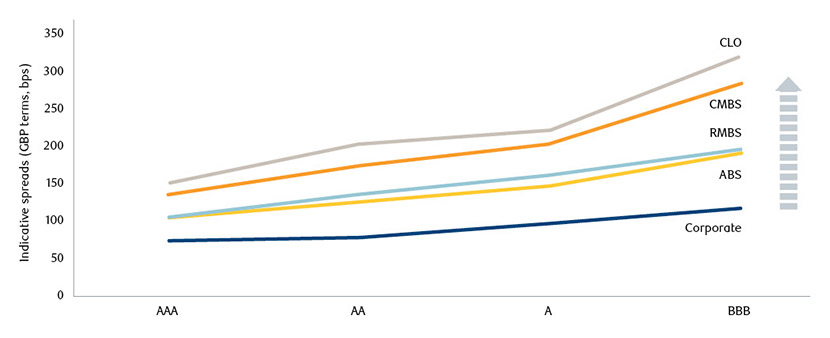
For investors seeking income, securitized credit offers the potential for higher returns relative to traditional bonds of a comparable credit rating. Figure 1 below illustrates the spread premium that securitized sub-asset classes offer when compared with global corporate credit.
Figure 1: securitized sub-asset class spreads versus corporate credit
For illustrative purposes only. There is no assurance that any of the trends depicted or described herein will continue.
Source: RBC BlueBay Asset Management, Bloomberg, recent issues in ABS/RMBS. As at 24 July 2026.
Adding securitized credit can also help investors optimise portfolio efficiency via greater diversification, as investors can gain exposure to a wider source of credit risk than is generated from corporates alone - for example, to the housing market, consumer or other asset-backed cash flows and their respective credit cycles. It also provides a means to express a wider range of investment views, on duration and relative value for example.
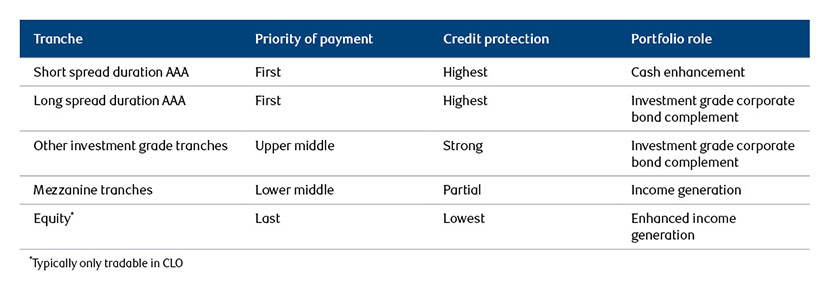
The most senior tranches in the capital structure, typically AAA, when accompanied by a very short spread duration, can offer cash enhancement. Although potential yields are lower than other tranches, albeit still above equivalent rated corporates, they have historically been extremely low volatility and low credit risk. These strategies typically appeal to insurers, corporates, and banks seeking high-quality, liquid income from a diversified source of returns.
Other investment grade tranches offer a higher spread premium to investment grade corporate bonds of a similar credit rating, as figure 1 shows. Given the diversification benefits of securitized credit – including exposure to a broader set of risk factors via the underlying collateral – these work well as a complement to corporate bond exposure. As such, they are typically favoured by pension funds, insurers and family offices with existing corporate credit allocations who seek diversification, shorter spread duration and predominantly floating rate exposure.
Meanwhile, non-investment grade mezzanine tranches (BB and lower) that have less structural protection, can act as a diversified source of higher income. The equity tranche, typically only tradable in CLOs, offers more enhanced income potential, albeit with higher risk as it is the first tranche to absorb losses if cash flows fall short. Both lower mezzanine and equity tranches would typically attract more specialist credit funds, family offices and enhanced income-seeking private bank clients with capacity to take greater credit risk in exchange for higher carry. These points are summarised in figure 2.
Figure 2: The spectrum of portfolio roles offered by securitized credit
Source: RBC BlueBay Asset Management, August 2026
A portfolio example
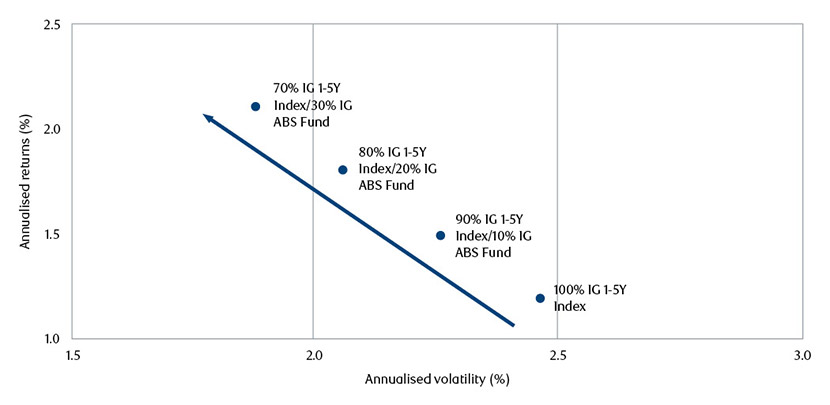
To illustrate one allocation use, in figure 3 we show the benefit of allocating to investment grade securitized credit within a broader investment grade sleeve, alongside investment grade corporate credit. In contrast to other asset classes, there is no commonly used benchmark to gauge long-term performance, so we show the BlueBay IG ABS Fund as a proxy for the broader asset class.
When compared to holding a portfolio of 100% investment grade short duration corporate bonds, incrementally higher allocations in investment grade securitized credit of a similar duration over the last five years resulted in higher returns and lower volatility. For example, a 30% allocation to the ABS Fund improved annualised returns by 0.91% while reducing volatility by 0.59% on an annualised basis.
Figure 3: Adding IG ABS to a fixed income allocation can increase returns while decreasing total portfolio volatility
Past performance is not indicative of future results
Improved risk-adjusted outcomes (EUR, based on 5Y historical data)
Source: RBC Global Asset Management, Bloomberg, as at 30 June 2026. Weekly data, last 5 years of history. The return on your investment may increase or decrease as a result of currency fluctuations if your investment is made in a currency other than that used in the past performance calculation. Fees and other expenses will have a negative effect on investment returns. Please see appendix for 10-year discrete performance data for BlueBay IG ABS Fund.
How the return drivers differ in securitized credit
Securitized credit is driven by different factors than traditional corporate bonds. These include consumer and real-economy credit cycles, the structural cash flow waterfall, and typically floating rate coupons – which reduce interest rate sensitivity and correlation to more traditional fixed income exposures. Meanwhile, spreads are set not by individual issuer funding needs but by the supply technicals between primary issuance and amortization payments. It is these drivers that result in the more versatile range of portfolio roles.
The differentiated drivers of securitized credit returns
- The collateral – the performance of securitized credit is primarily driven by the performance of the underlying assets generating the cash flows. These differ by sub-sector but are typically less correlated with one another, and with corporate bonds, given greater exposure to consumer and real-economy credit cycles.
- The structure – as we set out in our primer, the waterfall and structural subordination transform collateral risk into a spectrum of tranche profiles, which is what creates the range of portfolio roles.
- Floating rate nature – most securitized bonds pay a floating rate coupon, limiting interest rate sensitivity and reducing correlation to traditional fixed income. The amortizing profile means spread duration falls naturally as principal is returned, reducing mark-to-market sensitivity over time; another distinguishing feature relative to corporate bonds.
- Supply technicals – as with corporates, securitized spreads respond to supply technicals, but securitized supply is driven by underlying loan origination volumes rather than individual issuer funding timing. For investors, heavy supply can lead existing, secondary market, tranches to price lower on a mark-to-market basis, even when collateral is healthy.
Why this emphasises the importance of skilled active management. These same drivers, and the nuances between sub-asset classes, market inefficiencies, and lack of a representative benchmark are also what make the securitized credit market more challenging to navigate passively. We believe skilled active management is essential at every stage, from sourcing through to sub-asset class selection.
What do historical returns look like, and how has securitized credit behaved in periods of stress?
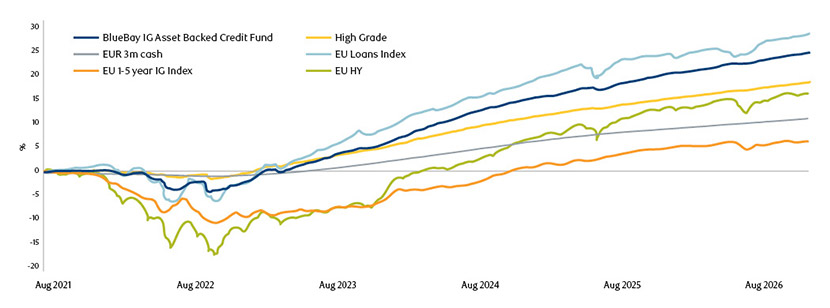
Securitized credit has delivered attractive returns over the longer term. We show the BlueBay IG ABS Fund as a proxy for broader asset class performance. It has delivered 2.28% annualised in excess of the risk-free component rate1 over the last five years to 31 August 2026 with volatility of 2.09%.
Figure 4: 5-year performance to August 2026
Past performance is not indicative of future results
Source: Bloomberg, RBC BlueBay Asset Management, as at 31 August 2026. The return on your investment may increase or decrease as a result of currency fluctuations if your investment is made in a currency other than that used in the past performance calculation. Performance figures shown are gross of fees and do not reflect the impact of fees, expenses, or other deductions. Actual returns may be lower once fees are considered. Please see appendix for 10-year discrete performance data for BlueBay IG ABS Fund.
Whilst long-term risk-adjusted returns have historically been favourable, it is often in periods of market stress, when correlations rise, that matter most. In this respect, securitized credit has actually been more resilient through recent macro shocks and market drawdowns than investment grade corporate bonds or the broader loans index. This is captured in figure 5, which shows the resilience of the asset class through the 2022 energy price and inflation shock, and more recently through the US-Iran conflict.
Figure 5: Performance during the initial phase of the 2026 US-Iran conflict
Past performance is not indicative of future results
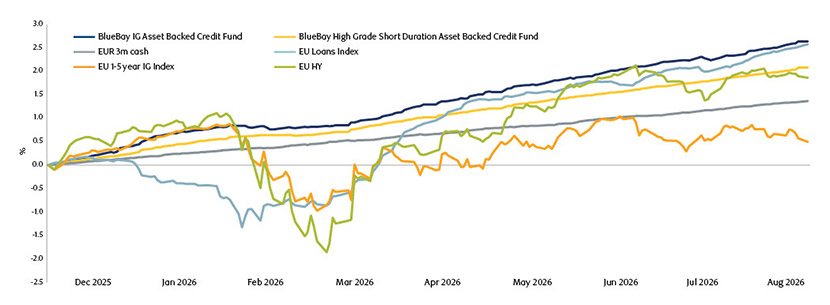
Source: Bloomberg, RBC BlueBay Asset Management, as at 31 August 2026. The return on your investment may increase or decrease as a result of currency fluctuations if your investment is made in a currency other than that used in the past performance calculation. Performance figures shown are gross of fees and do not reflect the impact of fees, expenses, or other deductions. Actual returns may be lower once fees are considered. Please see appendix for 10-year discrete performance data for BlueBay IG ABS Fund.
Securitized credit: a role within every fixed income allocation
The spectrum of risk and return profiles within securitized credit means it can meet a range of fixed income objectives: cash enhancement at the senior end when coupled with short spread duration; a diversifier to complement traditional investment grade exposures in the middle of the capital stack; and income in excess of corporate high yield in lower mezzanine positions. Few, if any, other fixed income asset classes offer this breadth of portfolio utility.
That breadth is increasingly recognised. Regulatory changes, including Solvency II reforms coming into force in 2027 and the UK Prudential Regulation Authority’s (PRA) matching adjustment framework, are expected to expand insurance sector allocations to assets with predictable, cash flow-backed structures. Securitized credit sits at the centre of that shift.
For investors yet to allocate, or holding a sub-scale position relative to the asset class's size and breadth, we believe the debate is not whether securitized credit warrants a place in the portfolio, but how much, and at which point in the capital stack.
Appendix

Source: RBC BlueBay Asset Management, as at 31 August 2026. The return on your investment may increase or decrease as a result of currency fluctuations if your investment is made in a currency other than that used in the past performance calculation. Performance figures shown are gross of fees and do not reflect the impact of fees, expenses, or other deductions. Actual returns may be lower once fees are considered.
1 ICE BofA Euro Currency 3-Month Deposit Offered Rate Constant Maturity Index