Global equities: where we do stop on the tariff staircase?

May 23, 2025

It’s remarkable global equity markets are up year-to-date given the extent of policy uncertainty. Jeremy Richardson explains the three potential tariff steps on the ‘Stairway to Liberation’, and discusses current market consensus and strategies to manage policy uncertainty in equity portfolios.

Key takeaways

  • The ongoing debate over trade policy and tariffs continues to create uncertainty in equity markets. The strength of the market rotation from the U.S. to Europe has diminished.
  • Q1 earnings were better than feared. But the range of policy outcomes remains wide and not everyone has been convinced by the recovery in equity markets.
  • Recent volatility is a reminder of the risks of macro-biases in portfolios. Careful monitoring and management of these will allow portfolio returns to be driven by individual holdings, in particular, quality companies run by strong management teams.


Tariff uncertainty collided with post-election optimism earlier this year. De-regulatory supply-side policies have a deflationary bias considered positive for corporate profits. Tariffs, on the other hand, have to be paid for, pushing up prices and disrupting supply chains. Fears of recession increased, creating ‘push’ factors for capital to leave the U.S.. This is in contrast to Europe where security fears encouraged governments to prioritise rearmament spending at the same time as interest rates continued to be cut.

Investors and companies still don’t have the tariff policy certainty they crave. Different voices argue for different outcomes, creating a ‘stairway to liberation’ of compounding policy actions.

The tariff ‘stairway to liberation’
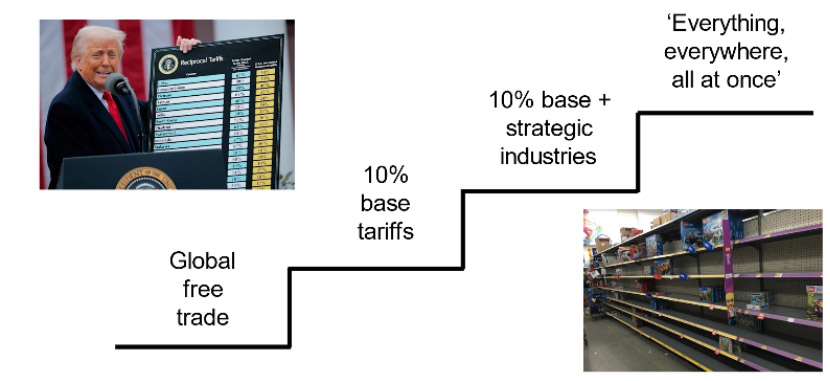
The tariff staircase: a tricky climb

The first step, a 10% tariff on all imports, would be frustrating for companies, investors and consumers. But it would likely not force companies to rapidly change supply chains and would raise significant revenue for government coffers.

Some argue it doesn’t go far enough. The next step builds on the first by adding in tariffs on strategic industries, like rare earths, semiconductors and pharmaceuticals to encourage domestic re-shoring and support U.S. economic security. This is a more interventionist approach but if limited to specific business models, it is one that the market should be able to price effectively.

The final step is essentially the full ‘Rose Garden’ treatment with reciprocal tariffs based upon existing trade deficits, in particular with China, with the goal of reindustrialisation. This last step was quickly priced into equity markets after the ‘Rose Garden’ announcement elevated the risk of recession.

Empty shelves in Walmart?

The 90-day moratorium on new tariffs came as a significant relief to equity markets. The implicit signal was that the risk of ‘everything, everywhere, all at once’ is significantly reduced. It was a well-timed intervention. Orders for Halloween and Christmas retail inventory need to be placed around now if product is to arrive in time, with delays risking empty shelves at Walmart. President Trump doesn’t want to be the President who cancelled Christmas.

Market consensus has moved back down the stairway and now appears to be somewhere between steps 1 and 2.

This is a better outcome than feared in early April that has helped equity markets recover their early Spring losses. The implied risk of recession has fallen from above 50% to somewhere in the 30s% (compared to a notional probability of 20-25% in any given year).

The only certainty is uncertainty

There are a few things we don’t yet know. Firstly, will there be a long-lasting trade agreement between the U.S. and China? Scott Bessent, Treasury Secretary, has said that neither country wants to ‘decouple’ from the other, which if true may indicate a settlement is possible. But this is in conflict with the re-industrialisation objective that requires a degree of inevitable decoupling, so who is right?

Secondly, even if outline deals are agreed in the next 60 days, will they be strong enough to give companies the confidence to invest? Or will delays cause an activity air-pocket and push the U.S. into recession anyway?

Finally, might we be looking at stagflation (lower growth and inflation above 2% for longer) or a ‘Goldilocks’ economy (3% growth and inflation 2-3%) in future? The market is looking for clues, hence the focus on ‘soft’ (current survey data) and ‘hard’ (backward-looking official data) economic indicators. Results so far are somewhat ambiguous.

So far, companies’ reported Q1 earnings have been better than feared. But Q1 was arguably always a ‘pass’ given that tariffs weren’t fully announced until the beginning of Q2. Earnings estimates have held up surprisingly well, despite ongoing policy uncertainty, but profit estimates often fade through the second half. Given valuations have recovered, this is leading many investors to ask ‘now what?’

Is the ‘great rotation’ taking a summer break?

The market rotation from the U.S. to Europe feels as though it has stalled. Tech stocks and ‘retail favourites’, such as Tesla, have been doing better lately. It is probably dangerous to be too dismissive of the U.S.. The natural advantages the country has in terms of its innovation-friendly eco-system, expanding demographics and high labour productivity all still mean that anyone looking to allocate their marginal dollar will have to consider the U.S. economy. The popularity of passive investment solutions in the U.S. also continues to act as a magnet for global capital as firms look to list in a market where passive means there is a surfeit of wealthy, value-agnostic investors.

In contrast, Europe has potential, but we have yet to see sustained commitment to the type of economic reforms and liberalisation that were set out in Mario Draghi’s 2024 report. A re-ordering of spending priorities in favour of defence is making new funds available which, together with falling interest rates, is supporting hopes of an improved environment to corporate profitability. However, this is a simple transient multiplier effect to growth – sustained economic growth probably requires supply-side reforms, the appetite for which remains unclear. A useful test-case for investors to monitor is cross-border banking consolidation, such as UniCredit’s approach to Commerzbank.

We let our companies do the talking

Our approach is a focus on company fundamentals, especially quality companies run by strong management teams, as they will be more resilient and will likely be able to take advantage of industry change better than weaker competitors. It is also important not to forget risk. Recent market volatility has highlighted the dangers of taking a strong market (beta) or country (U.S. versus Europe) view. Better to diversify such macro risks, monitor positive momentum exposure by not letting position sizes drift too far and let the company holdings do the talking.


Source: Bloomberg or publicly available data, as at May 2025.

Iscriviti per ricevere gli approfondimenti via mail

Iscriviti ora per ricevere gli ultimi approfondimenti economici e sugli investimenti dei nostri esperti, inviati direttamente alla tua casella di posta elettronica.

Il presente documento costituisce una comunicazione di marketing e può essere prodotto e distribuito dai soggetti di seguito specificati. Nello Spazio Economico Europeo (SEE) il soggetto autorizzato è BlueBay Funds Management Company S.A. (BBFM S.A.), che è regolamentata dalla Commission de Surveillance du Secteur Financier (CSSF). In Germania, Italia, Spagna e Paesi Bassi, BFM S.A. opera con un passaporto di filiale ai sensi della Direttiva sugli Organismi di investimento collettivo in valori mobiliari (2009/65/CE) e della Direttiva sui Gestori di Fondi di investimento alternativo (2011/61/UE). Nel Regno Unito, la produzione e distribuzione sono curate da RBC Global Asset Management (UK) Limited (RBC GAM UK), che è autorizzata e regolamentata dall’Autorità di vigilanza finanziaria del Regno Unito (FCA), registrata presso la Securities and Exchange Commission (SEC) statunitense e membro della National Futures Association (NFA) su autorizzazione della Commodity Futures Trading Commission (CFTC) statunitense. In Svizzera, la produzione e distribuzione sono curate da BlueBay Asset Management AG il cui Rappresentante e agente per i pagamenti è BNP Paribas Securities Services, Paris, succursale de Zurich, Selnaustrasse 16, 8002 Zurigo (Svizzera). Il luogo di adempimento è stabilito presso la sede legale del Rappresentante. I tribunali della sede legale del rappresentante svizzero o della sede legale o del luogo di residenza dell’investitore sono competenti per i reclami relativi all’offerta e/o alla pubblicità di azioni in Svizzera. Il Prospetto, i Documenti contenenti le informazioni chiave per gli investitori (KIID), i Documenti contenenti le informazioni chiave dei Prodotti d’investimento al dettaglio e assicurativi preassemblati (KID dei PRIIP), ove applicabili, lo Statuto e qualsiasi altro documento richiesto, come le Relazioni annuali e infrannuali, si possono ottenere gratuitamente dal Rappresentante in Svizzera. In Giappone, la produzione e distribuzione sono curate da BlueBay Asset Management International Limited, che è registrata presso il Kanto Local Finance Bureau del Ministero delle Finanze giapponese. In Asia, la produzione e distribuzione sono curate da RBC Global Asset Management (Asia) Limited, società registrata presso la Securities and Futures Commission (SFC) di Hong Kong. In Australia, RBC GAM UK è esente dall’obbligo di possedere una licenza australiana di servizi finanziari ai sensi del Corporations Act per quanto riguarda i servizi finanziari, in quanto è regolata dalla FCA secondo le leggi del Regno Unito che differiscono dalle leggi australiane. In Canada, da RBC Global Asset Management Inc. (che include PH&N Institutional), che è regolamentata dalle commissioni titoli provinciali e territoriali presso la quale è registrata. RBC GAM UK non è registrata ai sensi delle leggi sui valori mobiliari e si affida all'esenzione per i dealer internazionali prevista dalla legislazione provinciale applicabile sui valori mobiliari, che consente a RBC GAM UK di svolgere alcune attività specifiche di dealer per quei residenti canadesi che si qualificano come "cliente canadese autorizzato", in quanto tale termine è definito dalla legislazione applicabile sui valori mobiliari. Negli Stati Uniti, la produzione e distribuzione sono curate da RBC Global Asset Management (U.S.) Inc. (“RBC GAM-US”), una società di consulenza finanziaria registrata presso la SEC. Le entità di cui sopra sono collettivamente denominate “RBC BlueBay” all’interno del presente documento. Le registrazioni e adesioni effettuate non devono intendersi quale approvazione o autorizzazione di RBC BlueBay da parte delle rispettive autorità preposte al rilascio delle licenze o alla registrazione. I prodotti, i servizi o gli investimenti qui descritti possono non essere disponibili in tutte le giurisdizioni o essere disponibili solo su base limitata, a causa dei requisiti normativi e legali locali.

Il presente documento è destinato esclusivamente a “Clienti professionali” e “Controparti qualificate” (come definite dalla Direttiva sui mercati degli strumenti finanziari (“MiFID”) o dalla FCA); in Svizzera a “Investitori qualificati”, come definiti dall’Articolo 10 della Legge svizzera sugli investimenti collettivi di capitale e della relativa ordinanza attuativa; negli Stati Uniti, a “Investitori accreditati” (come definiti nel Securities Act del 1933) o ad “Acquirenti qualificati” (come definiti nell’Investment Company Act del 1940), a seconda dei casi, e non dev’essere considerato attendibile da altra categoria di clienti.

Se non diversamente specificato, tutti i dati sono stati forniti da RBC BlueBay. Per quanto a conoscenza di RBC BlueBay, il presente documento è veritiero e corretto alla data attuale. RBC BlueBay non rilascia alcuna garanzia esplicita o implicita né alcuna dichiarazione riguardo alle informazioni contenute nel presente documento e declina espressamente ogni garanzia di accuratezza, completezza o idoneità per un particolare scopo. Opinioni e stime derivano da una nostra valutazione e sono soggette a modifica senza preavviso. RBC BlueBay non fornisce consulenza in materia di investimenti né di altra natura e il presente documento non esprime alcuna consulenza né deve essere interpretato come tale. Il presente documento non costituisce un’offerta di vendita o la sollecitazione di un’offerta di acquisto di titoli o prodotti d’investimento in qualsiasi giurisdizione e ha finalità puramente informative.

È fatto divieto di riprodurre, distribuire o trasmettere, direttamente o indirettamente, ogni parte del presente documento a qualsiasi altra persona o di pubblicare, in tutto o in parte, i suoi contenuti per qualunque scopo e in qualsiasi modo senza il previo consenso scritto di RBC BlueBay. Copyright 2023 © RBC BlueBay. RBC Global Asset Management (RBC GAM) è la divisione di gestione patrimoniale di Royal Bank of Canada (RBC) che comprende RBC Global Asset Management Inc. (U.S.) Inc. (RBC GAMUS), RBC Global Asset Management Inc., RBC Global Asset Management (UK) Limited e RBC Global Asset Management (Asia) Limited, società indipendenti ma affiliate di RBC. ® / Marchio/i registrato/i di Royal Bank of Canada e BlueBay Asset Management (Services) Ltd. Utilizzato su licenza. BlueBay Funds Management Company S.A., sede legale all’indirizzo 4, Boulevard Royal L-2449 Luxembourg, società registrata in Lussemburgo con il numero B88445. RBC Global Asset Management (UK) Limited, con sede legale all’indirizzo 100 Bishopsgate, London EC2N 4AA, società in nome collettivo registrata in Inghilterra e Galles con il numero 03647343. Tutti i diritti riservati.

Iscriviti per ricevere gli approfondimenti via mail

Iscriviti ora per ricevere gli ultimi approfondimenti economici e sugli investimenti dei nostri esperti, inviati direttamente alla tua casella di posta elettronica.