The term ‘ESG’ is currently in decline in the corporate lexicon. A recent analysis earlier in the year of corporate filings from over 72,000 companies revealed a steep decline in ESG-related terminology1 since it peaked in 2021. The reasons behind this trend range from increasing regulatory complexities to political backlash and accusations of ‘greenwashing’. Perhaps there is even an aversion to the term in and of itself.
In hindsight, the reason for 2021 being the peak in that term’s usage is evident: the pandemic, growing concerns over climate change, and the actions of environmental groups, shifted attitudes against those companies with a clear disregard for any negative externalities they were responsible for, and rewarded those companies that were going above and beyond their profit-making goals and addressing long-term environmental and societal issues. Fund flows and performance mirrored this. However, as economies recovered, and life returned to ‘normal’, energy stocks roared back. Similarly, defence stocks have skyrocketed, following Russia’s invasion of Ukraine, as well as burgeoning conflict elsewhere around the world. ESG funds, often underweight these sectors, have underperformed. Additionally, as more and more examples of ‘greenwashing’ surfaced, it should come as no surprise that corporates have wound down their usage of the term.
The American futurist, Willis Harman, wrote a paper in 1974 entitled ‘Humanistic Capitalism: Another Alternative’. In it, he suggests that companies have responsibility for ensuring a “healthy society” and a “habitable planet”; this is not to improve their corporate image, nor as a “moralistically undertaken responsibility”, but because “it is the only reasonable long-run interpretation of ‘good business’”. In his view, good business policy must be aligned with good social policy.
As has been well documented, the friction between quasi-Friedmanites and those who espouse a version of Harman’s stakeholder responsibility has been particularly pronounced and public over the last decade. Perhaps the culmination of this is the rancour in the US as the current administration has become increasingly vocal on the subject of shareholder primacy. In our view there is no single point on the spectrum that is demonstrably ‘right’ or ‘better’ but instead investors and indeed the public at large would be well served by looking at individual businesses and their specific circumstances to understand what balance may lead to a business functioning to its potential.
Two European companies that demonstrate similar versions of the same principle are Brunello Cucinelli and Wise. The former is a leading manufacturer of luxury fashion apparel, while the latter is a fintech platform for low-cost cross-border money transfers. Both have adopted forms of Harman’s ‘Humanistic Capitalism’, either explicitly or implicitly, as core to their corporate culture. Profit, to these founders, is necessary, but not the ultimate goal. Instead, profits can be used to improve the quality of service, or the life of the workers, or investing in cultural and social projects.
Wise operates a business model that shares its scale economies with its customers. ‘Customer > team > ego’ is one of the key guiding principles at the company, or, in other words, the customer comes first, then the team, and finally the individual. They aim to limit the margin on cross border volumes to c.20%, with any extra profits re-invested in building a better infrastructure and lowering take rates for customers2. In effect, this means extending the competitive moat around their product in a profitable way. Ultimately, this builds trust with customers, making Wise the vendor of choice, driving higher volumes, and higher profits, which can in turn be re-invested; a virtuous cycle.
For Brunello Cucinelli, the adoption of the ‘Humanistic Capitalism’ concept is more explicitly stated. In his book, ‘The Dream of Solomeo’, Cucinelli recounts growing up in rural Italy, in contact with nature and as part of a large, closely-knit farming family. Even with plenty of mouths to feed, his grandfather would still give the first bale of wheat harvested back to the community. Everything changed when his father took a factory job. His father returned home with tearful eyes after being humiliated at work. It was this experience and reading Kant that shaped his thought: “Act in such a way that you treat humanity, whether in your own person or in the person of any other, never merely as a means to an end, but always at the same time as an end”. Brunello envisaged more pleasant workplaces, promoting the moral and economic dignity of humans; businesses that made a profit in an ethical and moral way.
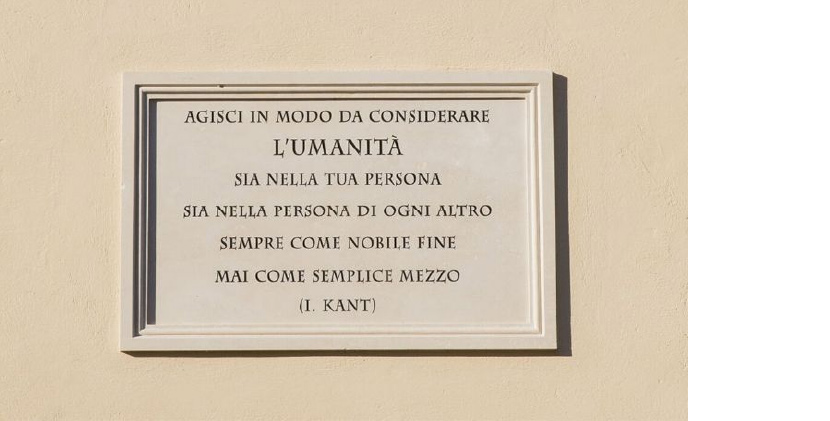
The words of Kant carved in a large plaque in Solomeo
Practically, this means ensuring employees work in pleasant settings, that they work a fair number of hours with “long and relaxing breaks”, earn adequate wages that exceed the going market rate, and feel like they are doing meaningful work. At Brunello Cucinelli, lunch breaks are one and half hours long, during which the factory is closed to allow workers to have lunch at home, should they choose. People are encouraged outside, and eating at desks is not permitted. Emails are not to be sent after hours or at weekends, and the workday (even for senior staff) is limited to between 8:00am and 5:30pm. In Brunello Cucinelli’s view, “this is the way it should be, everywhere”.
Beyond the company’s internal initiatives, they continue to allocate “a small part of the company's profits to beautify all of humanity”3. The company is based in Solomeo, a small 14th century medieval hamlet in Umbria. Slowly, they have restored the castle, the village, and its outskirts. They have built a theatre, a library, a park, and a school training the artisans of tomorrow.
Cucinelli attracts plenty of publicity – and criticism – due to the relative extremes of its working environment and supply chain. Critics will state that they are an exception, an anachronism that can only have survived in the affluent luxury industry. In most regards these criticisms are justified and perhaps it could only work for Cucinelli. But the positive feedback loop that it creates cannot be dismissed out of hand. Cucinelli has so far avoided the labour issues that many other Italian businesses have faced. Its refusal to cut costs by outsourcing its supply chain outside of Italy has resulted in the company avoiding the legal scrutiny and pitfalls that have befallen many other luxury goods companies in Europe in the last few years. There is also the halo effect of how desirability is amplified by notions of the artisanal, of purity, and the sense of inclusion in the lifestyle espoused by such distinctive products and the labour required to create them.
Wanting to prove financially what they believed morally, the team at Brunello Cucinelli set out to calculate a Social Return on Investment (SROI): ‘a quantitative measure of the social impacts generated against the economic value of the investments made by the company and related stakeholders’4. The conclusion: for the value of the investments dedicated over the years, the company has been able to generate a social return on investment twice as large. A value not (yet) flowing directly through the company’s P&L, but through its customers’ loyalty, its employees’ productivity, and the overall wellbeing of the hamlet of Solomeo.
This is perhaps the crux of the matter: profitability and shareholder value are too often measured in exceedingly short time periods. In the same manner that sustainable or ESG investing remains relatively nascent (a decade is too short a time period to make any reasonable judgements in the context of history) it is almost banal to point out that short-term financial gains and swift growth have a low correlation with long-term success. Diversity of business model is no bad thing; there is no ‘one-size-fits-all’ approach, and different industries may require very different working models. However, if the reflex against sustainability is founded in part due to the perception that it has failed from a corporate returns perspective, then it may be argued that the timeline is simply wrong. Companies such as Wise and Brunello Cucinelli offer different versions of the same proclamation: that the long-term route to the generation of sustainable profit is not necessarily set in stone.
1 ESG is quickly fading from corporate lexicon (World Economic Forum)
2 Wise Annual Report, 2023
3 Humanistic capitalism (Brunello Cucinelli.com)
4 Annual Financial Report (Brunello Cucinelli.com)