Key takeaways:
- A confluence of macro and geopolitical uncertainty, and tight corporate credit valuations: elevated macroeconomic and geopolitical uncertainty is driving volatility in rate expectations, keeping alive the risk of renewed credit volatility. At the same time, corporate credit valuations offer limited compensation for these risks, in contrast to securitized credit.
- There are six reasons why securitized credit can benefit investors now: on valuation, it offers a meaningful spread premium over equivalently rated corporates. On rate sensitivity, its floating-rate profile can help manage interest-rate risk. On risk, structural protection and diversification away from concentrated corporate credit provide resilience, whilst the ability to position in shorter spread duration can be beneficial in periods of volatility. And on fundamentals, the asset class maintains high-quality investment-grade ratings.
- Record issuance increasing opportunities for active investors: this year has seen record securitized credit issuance in Europe, driven by firm demand. This has been across a widening issuer base, opening the door to new opportunities for active managers.
We believe that the current macroeconomic and market conditions make the case for allocating to securitized credit particularly compelling. There is divergence in growth and an uncertain path for inflation globally, amid the rise of AI, and reverberations from the conflicts in Ukraine and in the Middle East.
All of these complicate the outlook for rates and risk assets. Meanwhile, corporate credit spreads sit at or near multi-year tights, offering thin compensation for risk at a time when uncertainty is elevated. By contrast, securitized credit continues to offer an attractive spread premium relative to corporate credit, due to its structural nuance as opposed to inferior credit quality. But as we discuss, this is not simply a valuation opportunity.
This note addresses why we believe the current market dynamic makes this an ideal time to invest in the asset class. We set out the structure and mechanics of the asset class in our primer, Securitized credit: an asset class primer, and the strategic case for a long-term allocation in our companion paper, Securitized credit: a versatile spectrum of portfolio roles.
Why securitized helps investors in this environment
1) Attractive spreads versus corporate credit. The spread premium on offer in securitized credit continues to compare favourably relative to equivalently rated corporate bonds (illustrated in figure 1). For example, an AA-rated CLO offers a spread pickup of 109 basis points over a corporate bond of equivalent rating and spread duration. This premium reflects market structure and technicals – the inefficiency and supply dynamics of the securitized market - rather than weaker credit quality. At a time when corporate spreads offer limited compensation for current risks, the additional carry provides a meaningful buffer against spread widening.
Figure 1: Spreads across credit assets
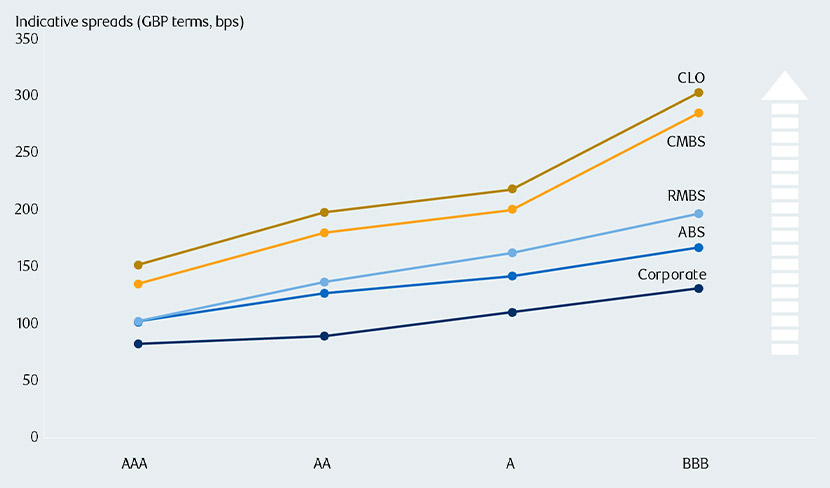
Source: RBS BlueBay Asset Management, Bloomberg, recent issues in ABS/RMBS. As at 30 September 2026.
2) Securitized credit is predominantly floating rate. This limits interest rate sensitivity and provides higher income when traditional fixed-rate bonds are under pressure. This is particularly valuable against a backdrop of rising short-term rates. Indeed, securitized credit can act as a strategic diversifier for portfolios with a natural long duration bias.
3) Amid rising macro uncertainty, the ability to position in shorter spread duration is valuable. Securitized credit offers multiple routes to achieve this, enabling investors to collect attractive carry with less sensitivity to spread movements, and adopt a more cautious stance without sacrificing income.
4) Structural protection. The structural subordination built into the asset class – where junior tranches absorb losses ahead of senior bondholders, reinforced by the ability to divert cash flows to senior tranches – provides a layer of resilience specific to credit volatility. We cover these structural protections in detail in our primer, but they are notably beneficial in the current environment, given elevated risk of credit volatility.
5) A source of diversification in the face of macro uncertainty. The more diversified nature of securitized relative to corporate credit is particularly valuable in a higher- volatility environment. Rather than concentrated exposure to the corporate credit cycle alone, securitized offers a wider range of risk factor exposures: consumer credit cycles in ABS, residential mortgage performance in RMBS, and leveraged loan collateral pools in CLOs. As a result, a diversified securitized credit portfolio (across ABS, MBS, CMBS, CLOs) carries significantly lower exposure to the technology sector than either corporate or private credit.
6) High-quality fundamentals: Average credit ratings for securitized credit portfolios are of high-quality investment grade. For all the macro and geopolitical turbulence this year, the fundamentals underpinning securitized credit have remained firm. For example, relative to corporate credit, the ratings downgrade-to-upgrade ratio has remained very low, as shown in figure 2.
Figure 2: EU ratings downgrade-to-upgrade ratios
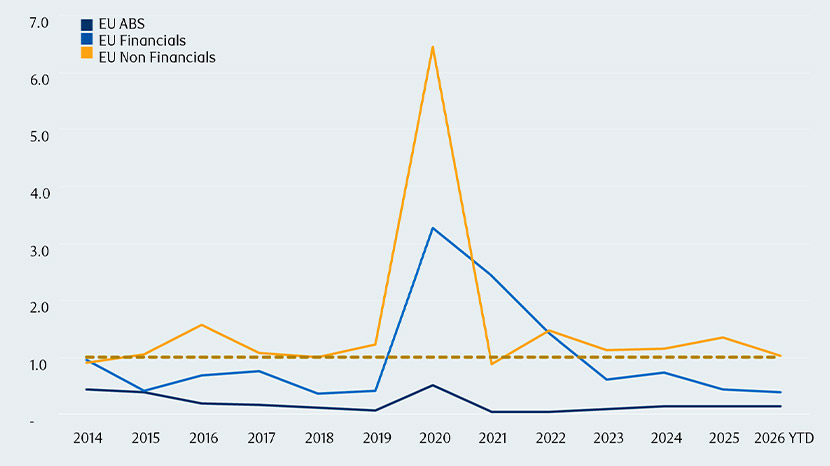
Source: Morgan Stanley Chartbook. Calendar year data - 2026 figure is YTD as at 31 August. Reading below 1 - more upgrades than downgrades.
Collateral performance across core ABS, RMBS and CLO sectors has stayed broadly stable, supported by high-quality underlying collateral and the structural protections built into the asset class. As we illustrate in our companion paper, Securitized credit: a versatile spectrum of portfolio roles, the asset class has been more resilient through recent macro shocks than investment grade corporate bonds.
Record issuance is creating greater opportunities for active investors
European securitized credit is seeing record levels of issuance, with all sub-sectors seeing growth, and on a gross basis is projected to hit EUR175 billion this year (figure 3). This is being driven by banks and other loan originators securitising a greater proportion of their own lending, underpinned by growing mortgage and consumer loan books. The issuer base is widening, and we do not see signs of a deterioration in underwriting standards.
Figure 3: European securitization issuance is booming
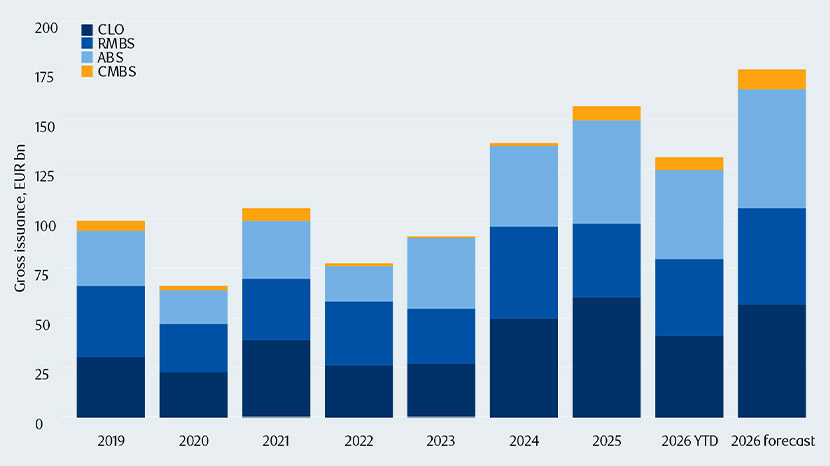
Source: Concept ABS, Bloomberg, Morgan Stanley, as at 7 September 2026. 2026 full year estimate from Morgan Stanley, based on current data and reasonable assumptions, and is not a reliable indicator of future results.
This is beneficial for active managers in terms of widening the opportunity set to new sectors and issuers. However, this requires even greater discretion from a selection perspective – securitized credit fundamentals in general are strong, but there are signs of softness in some pockets.
The opportunity in securitized credit today
Any of the factors described above would make securitized credit worthy of consideration. When combined, they emphasise an asset class which we believe is unusually well-positioned for the specific risks and dynamics of the current environment:
- where corporate credit offers tight spreads and sensitivity to single-issuer earnings, securitized credit offers wider spreads, lower correlation, and cash flows backed by diversified pools of underlying loans with structural protection.
- where long-duration assets are exposed to rising rates and sticky inflation, securitized credit offers the ability to position in floating-rate, shorter-duration exposures that benefit directly from rising coupons while limiting sensitivity to the rate moves.
- where structural features were once misunderstood and to be avoided, they are now recognised as a source of downside protection and natural deleveraging; the opposite of the downgrade drift in corporate credit.
The benefits of the securitized credit asset class are always compelling, but now more than ever the market environment highlights why a strategic allocation in securitized can benefit investor portfolios.