The $7 trillion question – when will cash come off the sidelines?

Sep 09, 2025

Marc Stacey, Senior Portfolio Manager for Investment Grade Credit, explains why the case for sitting in cash is weakening – and why even modest reinvestment flows back into credit markets could have a significant impact on performance.

Key takeaways

  • Cash is losing its shine as the investment grade yield pick-up re-emerges.
  • Even small shifts in asset allocation away from cash could have a big impact on spreads and returns.
  • Fundamentals look positive for the investment grade asset class, but selectivity remains key.


After a period of popularity, cash may be losing its shine. As interest rates started to normalise through 2022-23, investors poured vast sums into money market funds, attracted by yields of 5% or more on short-dated government paper and cash equivalents. According to data from the Federal Reserve Bank of St Louis, the total amount of cash parked in money market funds exceeded USD7 trillion in Q4 20241. In a world of rising rates, the shift to cash perhaps made sense – but the landscape has since changed.

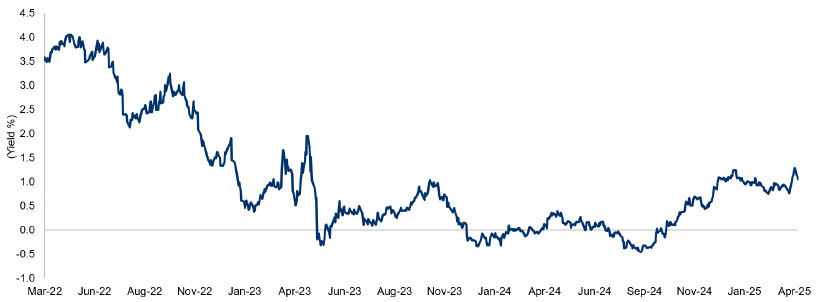
The chart below captures the nub of the issue. It shows how, as inflation emerged in 2022 and central banks responded in 2023, the extra yield on investment grade credit became compressed. To the extent that, from mid-2023 to late-2024, investors were effectively being paid the same to hold cash as they were for taking credit or duration risk. Inevitably, cash looked like a comfortable place to be during this time.

Out of money markets, into bonds? A $7 trillion question to consider…

Sitting in cash is no longer the more attractive option if rates are cut.

IG Yield vs. 1M Bills

IG Yield vs. 1M Bills chart

Source: Bloomberg, as at April 2025.

More recently, however, that has started to change. With official interest rates now beyond their peak, the argument for sitting tight in cash is weakening. Investment grade credit is offering a pick-up over cash – and investors are starting to take notice. Reinvesting that cash now looks increasingly compelling. For investors with longer-term horizons, the opportunity cost of sitting in cash is becoming harder to justify.

Small shifts, big consequences

Of course, the USD7 trillion currently sitting in money market funds is unlikely to be redeployed overnight. Many investors continue to value liquidity, and with policy rates still elevated and more uncertainty about their future path, cash can still play a useful role in portfolios. At the same time, other asset classes are competing for a share of this capital – some with compelling investment cases of their own.

Nevertheless, even a modest reallocation back into investment grade credit could have a meaningful impact. In parts of the market where issuance is limited and demand is strong, incremental inflows can move spreads quickly. Reinvestment doesn’t need to be a stampede – it just needs to begin. And there are early signs that it already has.

A supportive backdrop for investment grade credit

Even in today’s unsettled environment, the case for investment grade credit remains compelling. That’s partly because the quality of credit on offer is generally strong – supported by healthy balance sheets, robust earnings and relatively low default expectations. While policy uncertainty, including renewed trade tensions and a noisy political backdrop in the U.S., may cloud the macroeconomic outlook, our base case remains one of slowing – rather than collapsing – global growth. In that context, credit spreads continue to offer an appealing risk-reward trade-off for long-term investors, particularly in Europe. That provides a reassuring foundation for investors seeking stable income in an unpredictable environment.

Selectivity remains key

Against this backdrop, strategies with a proven ability to deliver strong risk-adjusted returns through the cycle may be particularly well placed to benefit. Not all credit is created equal, so selectivity remains key. Our strategies are currently underweight U.S. credit and overweight Europe, with a slight bias towards sectors such as financials and energy. This positioning reflects both fundamental strength and relative value, and we are confident that it will provide alpha on top of attractive core returns from the asset class.

To conclude, with yields on cash declining and the opportunity set in investment grade credit looking more attractive, investors can find several compelling reasons to re-engage with the asset class. Even modest reallocations from cash could prove influential – both for market dynamics and long-term portfolio outcomes.


1. Federal Reserve Economic Data as at 31 December 2025.

Sign up for insights by email

Subscribe now to receive the latest investment and economic insights from our experts, sent straight to your inbox.

This material is provided by RBC Global Asset Management (RBC GAM) for informational purposes only and may not be reproduced, distributed or published without the written consent of RBC GAM or its affiliated entities listed herein. This material does not constitute an offer or a solicitation to buy or to sell any security, product or service in any jurisdiction; nor is it intended to provide investment, financial, legal, accounting, tax, or other advice and such information should not be relied or acted upon for providing such advice. This material is not available for distribution to investors in jurisdictions where such distribution would be prohibited.


RBC GAM is the asset management division of Royal Bank of Canada (RBC) which includes RBC Global Asset Management Inc. (RBC GAM Inc.), RBC Global Asset Management (U.S.) Inc. (RBC GAM-US), RBC Global Asset Management (UK) Limited (RBC GAM-UK), and RBC Global Asset Management (Asia) Limited (RBC GAM-Asia), which are separate, but affiliated subsidiaries of RBC.


In Canada, this material is provided by RBC GAM Inc. (including PH&N Institutional), which is regulated by each provincial and territorial securities commission. In the United States (US), this material is provided by RBC GAM-US, a federally registered investment adviser. In the United Kingdom (UK) and Australia this material is provided by RBC GAM-UK, which is authorised and regulated by the UK Financial Conduct Authority. In the European Economic Area (EEA), this material is provided by BlueBay Funds Management Company S.A. (BBFM S.A.), which is regulated by the Commission de Surveillance du Secteur Financier (CSSF). In Germany, France, Sweden, Italy, Spain and Netherlands the BBFM S.A. is operating under a branch passport pursuant to the Undertakings for Collective Investment in Transferable Securities Directive (2009/65/EC) and the Alternative Investment Fund Managers Directive (2011/61/EU). In Spain, BlueBay Funds Management S.A is registered with the CNMV under No. 607. In Switzerland, this material is provided by BlueBay Asset Management AG where the Representative and Paying Agent is BNP Paribas Securities Services, Paris, succursale de Zurich, Selnaustrasse 16, 8002 Zurich, Switzerland. In Japan, this material is provided by BlueBay Asset Management International Limited, which is registered with the Kanto Local Finance Bureau of Ministry of Finance, Japan. In Asia, this material is provided by RBC GAM-Asia, which is licensed by the Securities and Futures Commission (SFC) in Hong Kong.


Additional information about RBC GAM may be found at www.rbcgam.com.


This material has not been reviewed by, and is not registered with any securities or other regulatory authority, and may, where appropriate and permissible, be distributed by the above-listed entities in their respective jurisdictions.


Any investment and economic outlook information contained in this material has been compiled by RBC GAM from various sources. Information obtained from third parties is believed to be reliable, but no representation or warranty, express or implied, is made by RBC GAM, its affiliates or any other person as to its accuracy, completeness or correctness. RBC GAM and its affiliates assume no responsibility for any errors or omissions in such information.


Opinions contained herein reflect the judgment and thought leadership of RBC GAM and are subject to change at any time. Such opinions are for informational purposes only and are not intended to be investment or financial advice and should not be relied or acted upon for providing such advice. RBC GAM does not undertake any obligation or responsibility to update such opinions.


RBC GAM reserves the right at any time and without notice to change, amend or cease publication of this information.


Past performance is not indicative of future results.
It is not possible to invest directly in an index.


Some of the statements contained in this material may be considered forward-looking statements which provide current expectations or forecasts of future results or events. Forward-looking statements are not guarantees of future performance or events and involve risks and uncertainties. Do not place undue reliance on these statements because actual results or events may differ materially from those described in such forward-looking statements as a result of various factors. Before making any investment decisions, we encourage you to consider all relevant factors carefully.


® / TM Trademark(s) of Royal Bank of Canada. Used under license.
© RBC Global Asset Management Inc., 2026

Sign up for insights by email

Subscribe now to receive the latest investment and economic insights from our experts, sent straight to your inbox.