Malin on the bloc....and other global markets

Sep 18, 2025

Malin Rosengren, Investment Grade Portfolio Manager, shares her thoughts on three interesting developments in global government bond markets.

1. Looking for fiscal anchors in a sea of rising debt

There has been much focus on debt sustainability and the balance between asset supply and asset demand, with France, US, UK, and Japan all coming into serious issues. While rising global government debt accumulation is undoubtedly nothing new, a shift towards fiscal dominance in the current environment rings alarm bells for bond investors.

What is different now?

  • Inflation remains elevated across developed markets globally – and will likely remain structurally higher, underpinned by the global transition away from free trade, globalisation, and open immigration politics. This implies that a higher equilibrium interest rate is likely required to contain inflation.
  • The pro-cyclicality of widening fiscal deficits and general lack of fiscal restraint, at a time when higher interest payments are eating away at government budgets. What was previously cheap debt accumulation becomes expensive in a higher interest rate environment. Meanwhile demographics are likely to put increasing pressure on government expenditures and to lead to further debt accumulation – thus increasing bond supply whilst reducing demand as retired savers pull money out of pensions.
  • This is happening globally – all at the same time.

A spotlight on: Japan

Japan was able to manage its demographic creep and accumulation of debt mainly due to the benefit of extremely low interest rates and the strength of its domestic demand base, combined with a massive QE program which led to the BoJ owning more than 50% of the Japanese government bond market. What’s different now is that interest rates are no longer at all-time lows, inflation remains elevated across advanced economies, and any move to ramp up QE programs will lead to currency depreciation and thus further inflationary pressure.

  • The Fed currently owns around a quarter of the UST market. If it were to attempt to ramp QE purchases up, investors would undoubtedly see the dollar weaken in kind.
  • While Japan’s pension funds were sizable enough to sustain demand previously, that is not a commonality across advanced economies – plus, even in Japan, domestic demand is waning.


What does this mean for investors?  

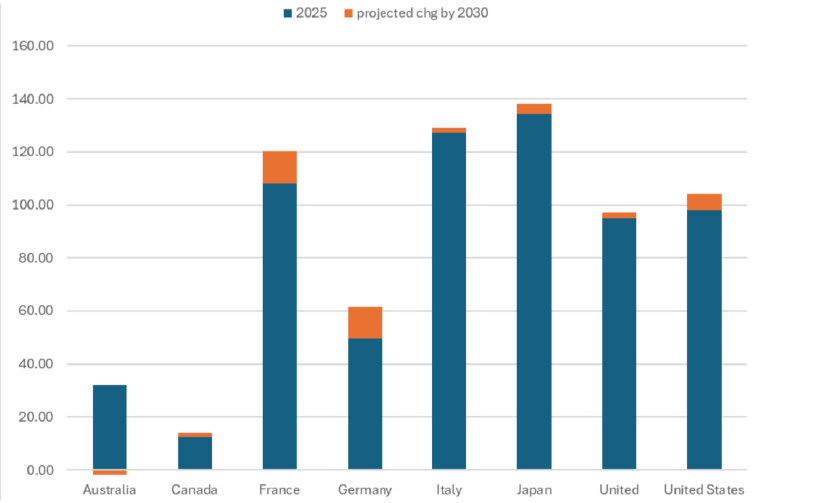
Credit quality becomes an increasingly important component to trading global government treasuries – particularly in the long-end of the curve. Investors should favour governments with lower net debt and showing fiscal restraint, with well-funded pension schemes. Australia stands out as particularly strong on these metrics – and a AAA-rated credit offering yields around 5% is, in our opinion, quite a compelling buy.

IMF fiscal monitor – net debt % of GDP

IMF fiscal monitor – net debt % of GDP

Source: IMF, as at April 2025.

2. Aussie dollar appeal

Domestically, the RBA looks to have little policy space to ease much further.

  • The headline inflation reading for the month of July jumped 0.9pp to 2.8% y-o-y, indicating underlying price pressures may be hotter than the central bank had been anticipating. While the reading was expected to come in higher as a result of electricity rebates, the jump in consumer prices was larger and broader than had been assumed.
  • Housing prices are back on the rise, evidence of one of the quickest policy transmissions globally, given the primacy of variable rate mortgages favoured by Australian homebuyers. Housing price growth also encourages household consumption through a positive wealth effect, which is particularly strong in Australia.
  • Real GDP growth is solid at 1.8% y-o-y in Q21, with household spending gaining momentum, as household wealth booms in a tight labour market.
  • Financial conditions may be looser than the RBA anticipates. Credit growth of 0.7% m-o-m / 7.2% y-o-y in July suggests the economy is leveraging back up.

What are the investment implications?

  • As we have shifted more materially dollar bearish, the Aussie dollar should be well supported. Fundamentals stack up well in terms of growth, interest rate differential (as the Fed eases and the RBA holds), ToT (iron ore prices strong), and the tail risk of potentially seeing super funds lift hedge ratios further from here.
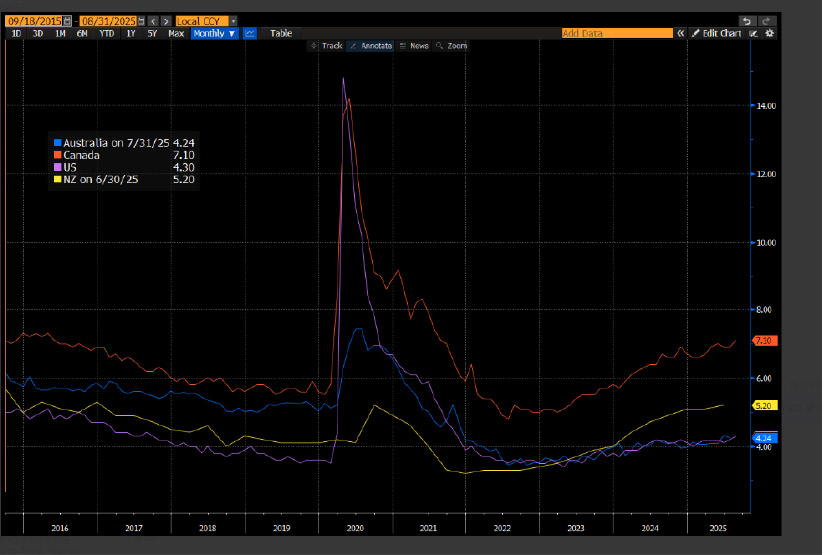
Unemployment rate across the dollar bloc

Unemployment rate across the dollar bloc chart

Source: Bloomberg, from 18 September 2015 to 31 August 2025.

3. Canada – more pain than anticipated, BoC to cut again

  • The Canadian labour market continued to weaken in August with a net change in employment data indicating another month of outright job losses of -65.5k (after -40.8k in July), and the unemployment rate ticked up further to 7.1%2.
  • The degree of weakness emerging in the Canadian economy comes as somewhat of a surprise, given Canada’s effective tariff rate in the US remains considerably lower than other trading partners and thus should advantage Canadian trade relative to peers.
  • The BoC will be sensitive to labour market weakness, which has been a key determinant in its reaction function through the easing cycle thus far. At the last BoC press conference in August, Macklem reiterated the bank will be focusing on how much export weakness spills over into employment, business investment, and household spending. Thus, the recent employment data offers the BoC a strong rationale to ease further.
  • The ability for the BoC to ease further will be limited by inflation pressures. Although headline inflation has been well behaved, core inflation has been regaining pace over the year and now sits at the upper threshold of the BoC’s target range.

What could happen next?

  • The BoC is unlikely to restart cuts after a pause and only do one more – therefore it’s likely to be a set of cuts if it does decide to move again. This should see the curve steepen further and beat forward pricing.
  • Canada is heading into USMCA re-negotiation risk, which will be the most critical factor in determining its ability to weather the storm. Although the USMCA comes up for renewal only in July next year, we are already seeing that the US is planning to take the first step towards the USMCA renegotiation within the next month (via public consultations). This will be the most important thing to watch.
  • A softening in US growth is an additional headwind to the Canadian economy.
  • Canada’s fiscal budget in October could offer a boost to the economy and has the potential to take some weight off monetary policy.


1. Australian National Accounts: National Income, Expenditure and Product, June 2025 | Australian Bureau of Statistics
2. Statistics Canada, 2025.

Sign up for insights by email

Subscribe now to receive the latest investment and economic insights from our experts, sent straight to your inbox.

This material is provided by RBC Global Asset Management (RBC GAM) for informational purposes only and may not be reproduced, distributed or published without the written consent of RBC GAM or its affiliated entities listed herein. This material does not constitute an offer or a solicitation to buy or to sell any security, product or service in any jurisdiction; nor is it intended to provide investment, financial, legal, accounting, tax, or other advice and such information should not be relied or acted upon for providing such advice. This material is not available for distribution to investors in jurisdictions where such distribution would be prohibited.


RBC GAM is the asset management division of Royal Bank of Canada (RBC) which includes RBC Global Asset Management Inc. (RBC GAM Inc.), RBC Global Asset Management (U.S.) Inc. (RBC GAM-US), RBC Global Asset Management (UK) Limited (RBC GAM-UK), and RBC Global Asset Management (Asia) Limited (RBC GAM-Asia), which are separate, but affiliated subsidiaries of RBC.


In Canada, this material is provided by RBC GAM Inc. (including PH&N Institutional), which is regulated by each provincial and territorial securities commission. In the United States (US), this material is provided by RBC GAM-US, a federally registered investment adviser. In the United Kingdom (UK) and Australia this material is provided by RBC GAM-UK, which is authorised and regulated by the UK Financial Conduct Authority. In the European Economic Area (EEA), this material is provided by BlueBay Funds Management Company S.A. (BBFM S.A.), which is regulated by the Commission de Surveillance du Secteur Financier (CSSF). In Germany, France, Sweden, Italy, Spain and Netherlands the BBFM S.A. is operating under a branch passport pursuant to the Undertakings for Collective Investment in Transferable Securities Directive (2009/65/EC) and the Alternative Investment Fund Managers Directive (2011/61/EU). In Spain, BlueBay Funds Management S.A is registered with the CNMV under No. 607. In Switzerland, this material is provided by BlueBay Asset Management AG where the Representative and Paying Agent is BNP Paribas Securities Services, Paris, succursale de Zurich, Selnaustrasse 16, 8002 Zurich, Switzerland. In Japan, this material is provided by BlueBay Asset Management International Limited, which is registered with the Kanto Local Finance Bureau of Ministry of Finance, Japan. In Asia, this material is provided by RBC GAM-Asia, which is licensed by the Securities and Futures Commission (SFC) in Hong Kong.


Additional information about RBC GAM may be found at www.rbcgam.com.


This material has not been reviewed by, and is not registered with any securities or other regulatory authority, and may, where appropriate and permissible, be distributed by the above-listed entities in their respective jurisdictions.


Any investment and economic outlook information contained in this material has been compiled by RBC GAM from various sources. Information obtained from third parties is believed to be reliable, but no representation or warranty, express or implied, is made by RBC GAM, its affiliates or any other person as to its accuracy, completeness or correctness. RBC GAM and its affiliates assume no responsibility for any errors or omissions in such information.


Opinions contained herein reflect the judgment and thought leadership of RBC GAM and are subject to change at any time. Such opinions are for informational purposes only and are not intended to be investment or financial advice and should not be relied or acted upon for providing such advice. RBC GAM does not undertake any obligation or responsibility to update such opinions.


RBC GAM reserves the right at any time and without notice to change, amend or cease publication of this information.


Past performance is not indicative of future results.
It is not possible to invest directly in an index.


Some of the statements contained in this material may be considered forward-looking statements which provide current expectations or forecasts of future results or events. Forward-looking statements are not guarantees of future performance or events and involve risks and uncertainties. Do not place undue reliance on these statements because actual results or events may differ materially from those described in such forward-looking statements as a result of various factors. Before making any investment decisions, we encourage you to consider all relevant factors carefully.


® / TM Trademark(s) of Royal Bank of Canada. Used under license.
© RBC Global Asset Management Inc., 2026

Sign up for insights by email

Subscribe now to receive the latest investment and economic insights from our experts, sent straight to your inbox.