Why go global in IG credit?

Jul 20, 2026

Key takeaways:

  • Invest in the best, wherever they are: going global allows IG investors to invest in the bonds they deem most attractive, taking the currency hedging costs and the outlook for government bond yields and credit spreads in different regions into account.
  • Focus on total return not just yield: focusing on the highest yielding bonds after hedging costs is too simplistic an approach to credit investing.
  • More choice, better potential outcomes: we believe that expanding the opportunity set and liquidity of the investable universe increases the chances of delivering improved risk-adjusted returns over the long term.


Most UK investors predominantly invest in sterling rather than global investment grade (IG) credit, despite taking a much more global approach with their equity investments. 

But we think it makes sense for many investors to diversify their sterling corporate bond exposure with an exposure to currency hedged global IG credit. Here’s why:

  1. FX risk can be hedged: investors can effectively neutralise the currency risk of investing in foreign bonds by hedging the FX risk.
  2. Reduce home bias, reduce recession risk: the sterling IG index has a bias towards UK and European companies, and away from US companies. Europe and the UK have had recessions without causing recessions in the US, whereas US recessions have generally caused recessions in Europe and the UK too.
  3. A larger and more liquid opportunity set: limiting oneself to sterling IG credit dramatically narrows the universe of available issuers and securities. The global IG market is also more liquid and the sterling high yield market is small, limiting its capacity to comfortably absorb fallen angels.

FX risk can be hedged

Rather than only buying sterling IG credit to eliminate currency risk, investors can buy the developed-market IG corporate bonds they deem most attractive from anywhere in the world, after taking currency hedging costs into account.

Successful credit investing is about much more than just picking the highest yielding bonds after factoring in hedging costs, otherwise anyone could be a star credit investor.

Higher yields can reflect higher government bond risk (rate, fiscal and political) or higher corporate credit risk. Higher yields can sometimes still rise further and deliver weaker total returns than lower yielding bonds.

The key is to assess the overall value of a bond taking the government bond yield, the credit spread and the currency hedging cost into account.

One must also compare equivalent credit and duration risks to ensure one is comparing apples to apples.

Reduce home bias, reduce recession risk?

The sterling corporate bond market comes with a huge bias away from US and towards UK companies, including a significant number of domestically focused firms.

Percentage of issuers in each index domiciled in selected countries/ regions (%):
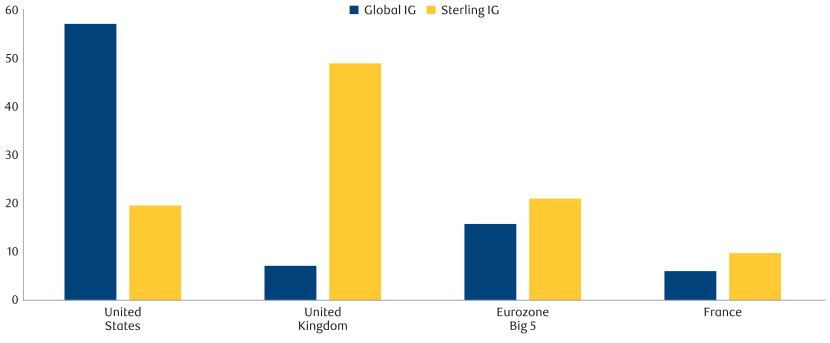
Chart Percentage of issuers in each index domiciled in selected countries/ regions (%)

Source: iShares (CRHG) holdings for global and Bloomberg for sterling, data as at 3 July 2026. Eurozone big 5 refers to Germany, France, Italy, Spain and the Netherlands.

Interestingly, the sterling IG corporate bond market is not only much more exposed to UK risk than the global IG corporate bond index, but it is also more exposed to Eurozone and French risk.

This bias away from the US can really matter because while it’s very unusual for the US to experience a recession without the UK and Europe also entering recession, it’s perfectly possible for the UK and/or Europe to experience a recession without the US also going into recession. The Eurozone for example experienced a sovereign debt crisis and recession in 2012, whereas the US avoided a recession and crisis.

With the US dollar the world’s reserve currency, and its debt denominated in a currency which it can print, the US is less exposed to potential sovereign debt crises than some Eurozone countries or the UK.

A larger and more liquid opportunity set

Limiting oneself to issuers who issue in sterling also dramatically limits one’s opportunity set.

Number of issuers in the global and sterling IG corporate bond indices:
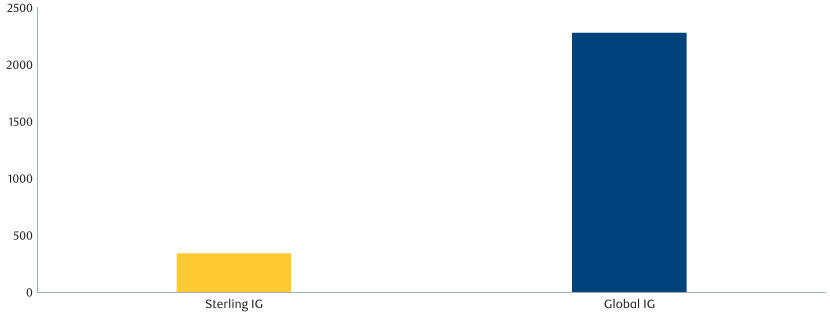
Chart Number of issuers in the global and sterling IG corporate bond indices

Source: Bloomberg. Data as at 30 June 2026

This results in a number of drawbacks:

  • New issue premiums - the extra yield offered by an issuer when issuing a new bond to entice investors to buy it over an existing bond - are a significant source of potential credit alpha. There are simply far fewer new issues available in sterling compared to the global investment grade market given the far larger number of issuers and issues in the global market.
  • One cannot express views on the outlook for bond yields/rates anywhere other than in the UK if you only invest in sterling credit markets. This eliminates the opportunity set that can come from being able to express relative value views on the outlook for bond yields across countries.
  • Sterling IG credit is less liquid than the far larger US and Euro denominated IG markets. This reduces active managers’ ability to add alpha.

The Sterling High Yield bond index is also very small.

This increases the price risk to bonds that get downgraded from IG to high yield in the next recession.

In a recession, the capacity of the local high yield bond market to absorb downgraded fallen angels matters. If the volume of previously BBB rated bonds that get downgraded overwhelms high yield investor demand in that currency, then it could lead to sharp price declines for downgraded bonds.

The proportion of IG indices which are BBB rated has increased in recent years:
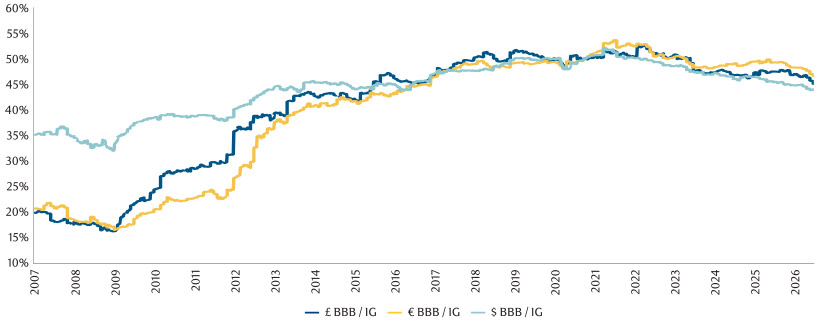
Chart The proportion of IG indices which are BBB rated has increased in recent years

Source: Bloomberg. Data as of 30 June 2026

The rising share of the IG indices which are BBB rated also emphasises the importance of being able to actively select the most attractively valued BBB rated bonds that the portfolio manager believes can avoid being downgraded in a recession. The larger the opportunity set, the better chance one has of identifying attractively valued bonds that won’t get downgraded.

The size of BBB rated IG bonds relative to HY bonds is much larger in sterling:
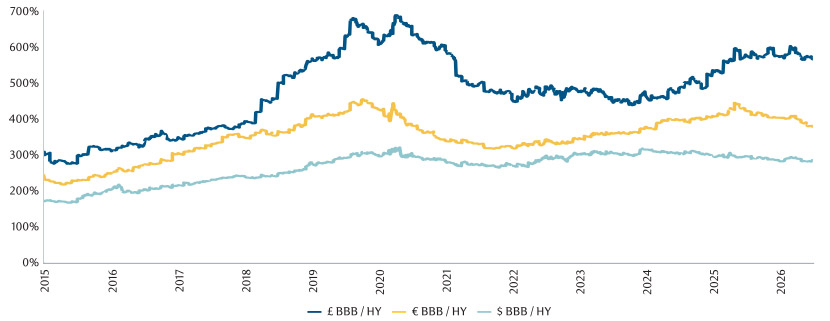
Chart The size of BBB rated IG bonds relative to HY bonds is much larger in sterling

Source: Bloomberg. Data as of 30 June 2026

Sign up for insights by email

Subscribe now to receive the latest investment and economic insights from our experts, sent straight to your inbox.

This document is a marketing communication and it may be produced and issued by the following entities: in the European Economic Area (EEA), by BlueBay Funds Management Company S.A. (BBFM S.A.), which is regulated by the Commission de Surveillance du Secteur Financier (CSSF). In Germany, Italy, Spain and Netherlands the BBFM S.A is operating under a branch passport pursuant to the Undertakings for Collective Investment in Transferable Securities Directive (2009/65/EC) and the Alternative Investment Fund Managers Directive (2011/61/EU). In the United Kingdom (UK) by RBC Global Asset Management (UK) Limited (RBC GAM UK), which is authorised and regulated by the UK Financial Conduct Authority (FCA), registered with the US Securities and Exchange Commission (SEC) and a member of the National Futures Association (NFA) as authorised by the US Commodity Futures Trading Commission (CFTC). In Switzerland, by BlueBay Asset Management AG where the Representative and Paying Agent is BNP Paribas Securities Services, Paris, succursale de Zurich, Selnaustrasse 16, 8002 Zurich, Switzerland. The place of performance is at the registered office of the Representative. The courts at the registered office of the Swiss representative or at the registered office or place of residence of the investor shall have jurisdiction pertaining to claims in connection with the offering and/or advertising of shares in Switzerland. The Prospectus, the Key Investor Information Documents (KIIDs), the Packaged Retail and Insurance-based Investment Products - Key Information Documents (PRIIPs KID), where applicable, the Articles of Incorporation and any other document required, such as the Annual and Semi-Annual Reports, may be obtained free of charge from the Representative in Switzerland. In Japan, by BlueBay Asset Management International Limited which is registered with the Kanto Local Finance Bureau of Ministry of Finance, Japan. In Asia, by RBC Global Asset Management (Asia) Limited, which is registered with the Securities and Futures Commission (SFC) in Hong Kong. In Australia, RBC GAM UK is exempt from the requirement to hold an Australian financial services license under the Corporations Act in respect of financial services as it is regulated by the FCA under the laws of the UK which differ from Australian laws. In Canada, by RBC Global Asset Management Inc. (including PH&N Institutional) which is regulated by each provincial and territorial securities commission with which it is registered. RBC GAM UK is not registered under securities laws and is relying on the international dealer exemption under applicable provincial securities legislation, which permits RBC GAM UK to carry out certain specified dealer activities for those Canadian residents that qualify as "a Canadian permitted client”, as such term is defined under applicable securities legislation. In the United States, by RBC Global Asset Management (U.S.) Inc. ("RBC GAM-US"), an SEC registered investment adviser. The entities noted above are collectively referred to as “RBC BlueBay” within this document. The registrations and memberships noted should not be interpreted as an endorsement or approval of RBC BlueBay by the respective licensing or registering authorities. Not all products, services or investments described herein are available in all jurisdictions and some are available on a limited basis only, due to local regulatory and legal requirements.

This document is intended only for “Professional Clients” and “Eligible Counterparties” (as defined by the Markets in Financial Instruments Directive (“MiFID”) or the FCA); or in Switzerland for “Qualified Investors”, as defined in Article 10 of the Swiss Collective Investment Schemes Act and its implementing ordinance, or in the US by “Accredited Investors” (as defined in the Securities Act of 1933) or “Qualified Purchasers” (as defined in the Investment Company Act of 1940) as applicable and should not be relied upon by any other category of customer.

Unless otherwise stated, all data has been sourced by RBC BlueBay. To the best of RBC BlueBay’s knowledge and belief this document is true and accurate at the date hereof. RBC BlueBay makes no express or implied warranties or representations with respect to the information contained in this document and hereby expressly disclaim all warranties of accuracy, completeness or fitness for a particular purpose. Opinions and estimates constitute our judgment and are subject to change without notice. RBC BlueBay does not provide investment or other advice and nothing in this document constitutes any advice, nor should be interpreted as such. This document does not constitute an offer to sell or the solicitation of an offer to purchase any security or investment product in any jurisdiction and is for information purposes only.

No part of this document may be reproduced, redistributed or passed on, directly or indirectly, to any other person or published, in whole or in part, for any purpose in any manner without the prior written permission of RBC BlueBay. Copyright 2023 © RBC BlueBay. RBC Global Asset Management (RBC GAM) is the asset management division of Royal Bank of Canada (RBC) which includes RBC Global Asset Management (U.S.) Inc. (RBC GAM-US), RBC Global Asset Management Inc., RBC Global Asset Management (UK) Limited and RBC Global Asset Management (Asia) Limited, which are separate, but affiliated corporate entities. ® / Registered trademark(s) of Royal Bank of Canada and BlueBay Asset Management (Services) Ltd. Used under licence. BlueBay Funds Management Company S.A., registered office 4, Boulevard Royal L-2449 Luxembourg, company registered in Luxembourg number B88445. RBC Global Asset Management (UK) Limited, registered office 100 Bishopsgate, London EC2N 4AA, registered in England and Wales number 03647343. All rights reserved.

Sign up for insights by email

Subscribe now to receive the latest investment and economic insights from our experts, sent straight to your inbox.