Ways to access emerging market debt

Feb 05, 2026

We introduce a framework to help investors consider the most suitable way to access EMD including benchmark relative and several benchmark agnostic strategies, including unconstrained, absolute return (long/short) and private credit.

Passive investment in EMD is sub-optimal and investors should tread carefully

EMD markets can, at times, be significantly inefficient and volatile with meaningful dispersion between the best and worst performing bonds. Passive investors could therefore be tied into highly volatile returns. In contrast, active investors are in a position to avoid the potential pitfalls associated with deteriorating credit developments and can employ downside protection strategies to mitigate negative periods in the market, allowing for a attractive risk-return profile.

Active funds can also benefit from a larger investable universe with the option of investing in off-benchmark positions. These may include bonds that lie outside the index yet offer higher risk-adjusted return potential, or bonds issued by smaller issuers that the index might not capture due to liquidity or other constraints defined by the index provider.

This is particularly relevant in the EM local currency market, which accounts for approximately 80% of the global EM debt universe1, yet the key indices only represent about 20% of the investable local market universe. This means the benchmark is highly concentrated amongst the high beta local currency markets and can be very volatile and not necessarily a true reflection of the overall sub-asset class. As a result, passive investors miss a vast opportunity to diversify outside of the benchmark and potentially boost returns.

A framework to help identify the most suitable active approach

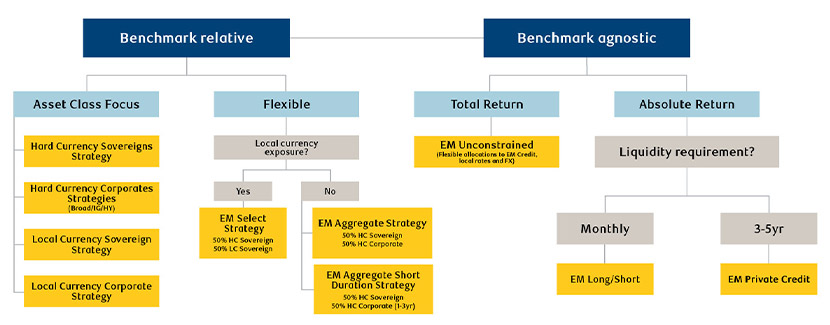
Below, we introduce a framework to help investors consider the most suitable way to access EMD, based on their requirements with respect to benchmark, liquidity, flexibility regarding asset class exposure and yield. We illustrate this spectrum in Figure 1, using the strategies we offer to our clients as examples.

Benchmark relative

  • Asset class focus: Investors who aim to gain exposure to the beta of a specific sub-asset class (e.g. to perform a specific role in a multi-manager portfolio or because of a strong view on certain asset classes), can invest in strategies where the manager seeks to outperform this sub-asset class benchmark over a cycle.
  • Flexible: Investors with more flexibility, but still seeking benchmark-relative returns, can target strategies which span multiple asset classes, but allow their active manager some flexibility to allocate between these sub-asset classes. These strategies aim to produced higher overall returns and lower volatility than holding separate single asset class investments as managers have an additional active lever to pull.

Benchmark agnostic

  • Total return, unconstrained (long-biased): These ‘go anywhere’ strategies are for investors who want the ability to capture the attractive upside available in EMD though a high conviction portfolio, but would like more flexibility to limit the downside during periods of high volatility, often using derivatives to manage risk quickly and efficiently. These are still long-biased solutions, but without the constraints of a market benchmark. They can help to smoothen the volatility of investments over the long term.
  • Absolute return, long/short (hedge fund): For investors who have the ability to allocate to long/short hedge funds, these strategies are similar to unconstrained strategies but have the added ability to short bonds. These are designed to be market neutral and generate strong positive returns irrespective of the underlying market environment. Typically, liquidity will be limited to monthly or longer and net return targets will be double-digits.
  • Private credit: For investors able to lock up their capital for multiple years, a private credit strategy can target 15+% gross and net IRR in excess of 12%, annualised. In an uncertain and volatile environment, when demand for EM corporate issuance may be unreliable, healthy corporates in EM often choose the private credit route for funding smaller or shorter maturity financing requirements, often at a premium versus their funding costs in the liquid, public markets. As a result, investors in EM private credit can earn a healthy premium whilst still focusing on higher quality credits. At times, private market lenders, particularly banks, will need to reduce their balance sheets for reasons unrelated to the specific underlying assets. Given the illiquid nature of the private credit markets within EM, this activity can cause temporary asset price dislocations. Investors in a position to take advantage of these dislocations can generate an additional return pick up in their private credit portfolios.
Figure 1: Finding the best solution for EMD exposures

Finding the best solution for EMD exposures

Source: RBC GAM, as at December 2024


1  RBC Global Asset Management as of 31 December 2024.

Sign up for insights by email

Subscribe now to receive the latest investment and economic insights from our experts, sent straight to your inbox.

This material is provided by RBC Global Asset Management (RBC GAM) for informational purposes only and may not be reproduced, distributed or published without the written consent of RBC GAM or its affiliated entities listed herein. This material does not constitute an offer or a solicitation to buy or to sell any security, product or service in any jurisdiction; nor is it intended to provide investment, financial, legal, accounting, tax, or other advice and such information should not be relied or acted upon for providing such advice. This material is not available for distribution to investors in jurisdictions where such distribution would be prohibited.


RBC GAM is the asset management division of Royal Bank of Canada (RBC) which includes RBC Global Asset Management Inc. (RBC GAM Inc.), RBC Global Asset Management (U.S.) Inc. (RBC GAM-US), RBC Global Asset Management (UK) Limited (RBC GAM-UK), and RBC Global Asset Management (Asia) Limited (RBC GAM-Asia), which are separate, but affiliated subsidiaries of RBC.


In Canada, this material is provided by RBC GAM Inc. (including PH&N Institutional), which is regulated by each provincial and territorial securities commission. In the United States (US), this material is provided by RBC GAM-US, a federally registered investment adviser. In the United Kingdom (UK) and Australia this material is provided by RBC GAM-UK, which is authorised and regulated by the UK Financial Conduct Authority. In the European Economic Area (EEA), this material is provided by BlueBay Funds Management Company S.A. (BBFM S.A.), which is regulated by the Commission de Surveillance du Secteur Financier (CSSF). In Germany, France, Sweden, Italy, Spain and Netherlands the BBFM S.A. is operating under a branch passport pursuant to the Undertakings for Collective Investment in Transferable Securities Directive (2009/65/EC) and the Alternative Investment Fund Managers Directive (2011/61/EU). In Spain, BlueBay Funds Management S.A is registered with the CNMV under No. 607. In Switzerland, this material is provided by BlueBay Asset Management AG where the Representative and Paying Agent is BNP Paribas Securities Services, Paris, succursale de Zurich, Selnaustrasse 16, 8002 Zurich, Switzerland. In Japan, this material is provided by BlueBay Asset Management International Limited, which is registered with the Kanto Local Finance Bureau of Ministry of Finance, Japan. In Asia, this material is provided by RBC GAM-Asia, which is licensed by the Securities and Futures Commission (SFC) in Hong Kong.


Additional information about RBC GAM may be found at www.rbcgam.com.


This material has not been reviewed by, and is not registered with any securities or other regulatory authority, and may, where appropriate and permissible, be distributed by the above-listed entities in their respective jurisdictions.


Any investment and economic outlook information contained in this material has been compiled by RBC GAM from various sources. Information obtained from third parties is believed to be reliable, but no representation or warranty, express or implied, is made by RBC GAM, its affiliates or any other person as to its accuracy, completeness or correctness. RBC GAM and its affiliates assume no responsibility for any errors or omissions in such information.


Opinions contained herein reflect the judgment and thought leadership of RBC GAM and are subject to change at any time. Such opinions are for informational purposes only and are not intended to be investment or financial advice and should not be relied or acted upon for providing such advice. RBC GAM does not undertake any obligation or responsibility to update such opinions.


RBC GAM reserves the right at any time and without notice to change, amend or cease publication of this information.


Past performance is not indicative of future results.
It is not possible to invest directly in an index.


Some of the statements contained in this material may be considered forward-looking statements which provide current expectations or forecasts of future results or events. Forward-looking statements are not guarantees of future performance or events and involve risks and uncertainties. Do not place undue reliance on these statements because actual results or events may differ materially from those described in such forward-looking statements as a result of various factors. Before making any investment decisions, we encourage you to consider all relevant factors carefully.


® / TM Trademark(s) of Royal Bank of Canada. Used under license.
© RBC Global Asset Management Inc., 2026

Sign up for insights by email

Subscribe now to receive the latest investment and economic insights from our experts, sent straight to your inbox.