Key takeaways:
- The risk-adjusted profile is structurally attractive: convertible bonds offer the potential to generate equity-like returns, but with lower volatility and downside protection through market shocks.
- A rich opportunity set unavailable elsewhere: record issuance, a higher-quality issuer base, and a shift toward capex-funded deals have expanded and upgraded the universe. These exposures are unavailable in most other fixed income asset classes.
- The current environment is particularly supportive: rising cross-asset volatility, a refinancing pipeline, and an equity backdrop characterised by a strong earnings outlook and historically cheap valuations all favour an asset with low duration and embedded equity optionality.
Convertible bonds offer the potential for equity-like upside with lower volatility, portfolio diversification, and access to what we believe is a rich opportunity set.
In the post-global financial crisis low interest rate environment, convertibles issuance was subdued, and the asset class fell out of favour. This trend changed in the pandemic, and despite a dip in 2022, issuance is once again booming. At $600 billion and growing, we believe the asset class is becoming harder for allocators to continue to overlook.
This note recaps the mechanics of convertible bonds, highlights how these hybrid securities can diversify investor portfolios, and why now may be an opportune moment to revisit the asset class.
Why the risk-adjusted profile of convertible bonds is structurally attractive
- Recap on convertibles: convertibles are corporate bonds with an embedded equity call option. The bond floor limits downside; the equity option captures upside. The defining property is convexity – convertibles participate in more of the equity's upside than its downside.
- Downside protection has been demonstrated across multiple episodes. In the July AI-valuation correction, the early-2020 pandemic, and war-related sell-offs, converts drew down less than equities and recovered more quickly. Converts can experience sharp short-term reversals, but recoveries tend to be very quick.
- Crucially, convertibles are not a static mechanical blend of equities and bonds. Their behaviour shifts with the underlying share price, interest rates, credit spreads, and volatility – which is what makes them a diversifier rather than a redundant holding.
Where do convertibles sit in a portfolio?
The primary case for allocating to convertibles is diversification - and it is more important than ever in the current environment. However, there can be genuine confusion about whether to classify them in the equity or fixed income sleeve. In practice, convertibles can play a role in both:
- Within an equity allocation: convertibles can act as a "middle stop" - a way to retain equity upside while reducing risk, rather than a full exit to bonds. Because converts are essentially bonds with call options attached, timing the market is less critical than with equities; the bond floor provides downside protection while waiting for the option to play out. For investors looking to de-risk without forfeiting participation, they offer potential to bridge the gap between holding equities and holding bonds.
- Within a fixed income allocation: convertibles offer the potential for duration reduction – for example, moving from high yield to converts reduces portfolio duration, an advantage when rates are volatile. The low running yield may look unappealing at first glance, but that low carry is a feature, not a bug: issuers offer zero coupons because the equity call option compensates for lending at zero percent. The return comes from the option, not the coupon.
The point is that for many allocators, convertibles are neither equity nor fixed income – they are a hybrid that diversifies against both asset classes. That is precisely why they deserve their own bucket rather than being absorbed into one sleeve or the other.
The opportunity set is richer than almost any point in history
- Strong issuance is a positive signal. Unlike straight fixed income, where heavy issuance can be a negative signal, strong convertibles issuance historically correlates with strong asset-class performance. This is because it means stocks are doing well and companies expect further appreciation.
Global convertible issuance at record level
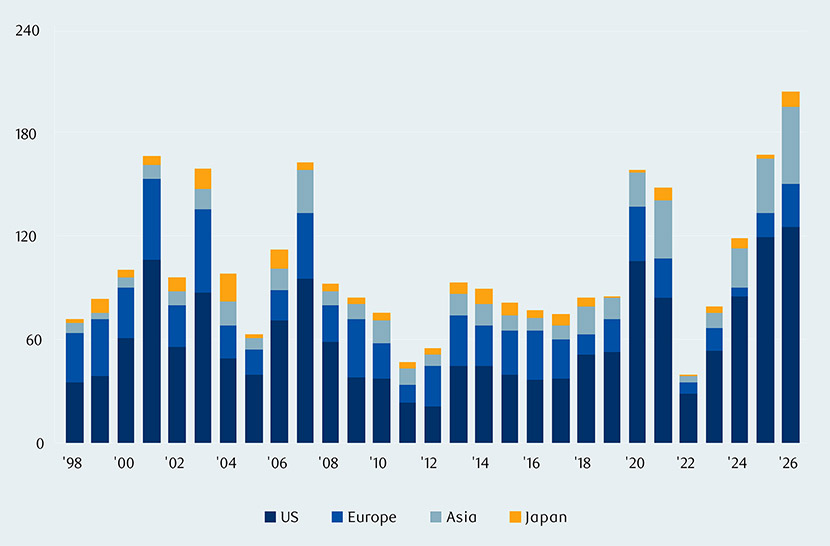
Source: BofA Global Research, calendar year data, except for 2026 which is year-to-date as at 20 September 2026. USD million.
- The convert universe has typically offered distinct exposure relative to equity or credit benchmarks. Today the issuer base has exposure to a broad range of growth areas, including some which are absent or underrepresented in many credit indices, such as AI, infrastructure, and semiconductor themes.
Regionally, the US makes up the majority of issuance while Asia continues to expand. This regional dispersion gives allocators flexibility to tilt toward the growth profile that best complements their existing holdings.
Global convertible bonds offer exposure to a diverse range of industries
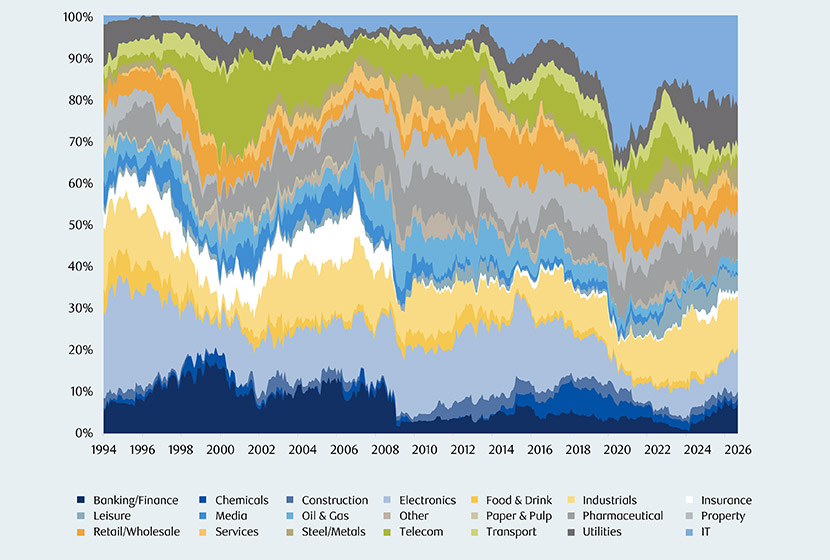
Source: FTSE, RBC BlueBay Asset Management, as at 30 September 2026. Monthly industry share in the FTSE Global Convertible Bond index. Global convertible bond index exposure by industry.
- A hedge-fund-dominated investor base creates room for the patient long-only investor. The current investor base is approximately 60–65% hedge fund money, up from approximately 60% long-only historically. Hedge funds move money quickly and can cheapen convertible bonds even when underlying stocks are fine, keeping a lid on valuations. For a patient long-only investor, we believe that this dynamic can create more opportunity, but it also means convertibles can cheapen independently of issuer fundamentals when hedge funds reposition. Moreover, it emphasise why, in our view, active management and fundamental selectivity are essential.
Why cross-asset volatility makes the asymmetric payoff especially valuable
The late cycle macro environment, together with significant geopolitical uncertainty has driven recent bouts of volatility. Large relative moves are being seen across rates and FX, and to a lesser extent in equities - demonstrating why diversification away from pure duration assets is valuable.
This is where convertibles' asymmetric profile comes into its own: drawdowns are typically shallower and recovery is faster than in equities, as demonstrated in the July AI-valuation correction, the pandemic, and war-related sell-offs. With low duration, convertibles can buffer portfolios when rates rise, while the embedded equity option preserves upside participation. For equity investors looking to de-risk without forfeiting upside, convertibles can act as a "middle stop" – locking in gains while retaining optionality.
What are the risks?
Record issuance does not guarantee investor-friendly terms. Half of new convertibles in 2026 have priced with no coupon at all, up from 17% in 2023, and the average coupon has fallen from 2.9% to 1.8%.
Some of this reflects the higher equity volatility of the AI-heavy issuer base, which increases embedded option value – but strong demand has shifted terms toward issuers.
Capex-funding deals also require a different analytical lens. A refinancing is primarily a credit question; a capex-funding deal requires investors to judge whether assets yet to be built will generate expected returns.
Active management and fundamental selectivity are essential. Passive index exposure, in a market this dispersed, is insufficient.
The opportunity in plain sight
What makes this moment unusual is that the structural case and the tactical case are converging.
The convexity, diversification, and low duration that make convertibles a permanent portfolio tool are the same properties that make them particularly well-suited to today's environment of macro and rate volatility. Added to this is the record issuance cycle, exposure to growth sectors, and still reasonable current valuations. We believe this is an opportunity in plain sight.
Reprinted by permission. Copyright © 2026 Bank of America Corporation (“BAC”). The use of the above in no way implies that BAC or any of its affiliates endorses the views or interpretation or the use of such information or acts as any endorsement of the use of such information. The information is provided "as is" and none of BAC or any of its affiliates warrants the accuracy or completeness of the information.
Under no circumstances shall BofA Securities or affiliates be liable to you or any third party for any damages (including but not limited to direct, indirect, special and consequential damages), losses, expenses, fees, or other liabilities that directly or indirectly arise from this license, the Report or the Content or your use of the materials. You hereby waive and release BofA Securities and affiliates from any claims for damages, losses, expenses, fees, liabilities, causes of action, judgments and claims arising out of or related to your use of the Report or the Content, whether now existing or arising in the future.
You recognize that information contained in the Content or Report may become outdated and that BofA Securities and affiliates are under no obligation to update the Content or Report or notify you of any changes to the Content or Report. The Report and Content are provided "AS IS," and none of BofA Securities and affiliates make any warranty (express or implied) with respect to the Report or any content including the Content, including, without limitation, any warranty of ownership, validity, enforceability or non-infringement, the accuracy, timeliness, completeness, adequacy, merchantability, fitness for a particular purpose, or suitability of the material for any intended audience.